
 ENG
ENG
 English
 русский
 한국어
한국어 Deutsch
Submit feedback
News
 Home / News / Industry News / Power Strip 15 ft Cord: What to Check Before You Buy a Long-Cord Strip Safely
 Power Strip 15 ft Cord: What to Check Before You Buy a Long-Cord Strip Safely
 2026.08.10
 Industry News
The wall outlet sits 14 feet from your desk, measured around the doorframe because there is no straight path. You need power for a monitor, a laptop charger, a desk lamp, and a phone charger. A standard 6-foot strip will not reach, and plugging two strips together creates a risk that no electrician would approve. A power strip 15 ft long is the practical fix. Whether it is also a safe one depends on four details: the conductor gauge, the overload protection, the housing material, and the certifications.
Here is the conclusion up front: a 15 ft power strip is only as good as its cord and its protective components. If those are specified correctly, the long cord is a durable, convenient part of a permanent setup. If they are not, the same length that makes the strip useful also makes it a hidden hazard.
Content
What changes when you add 15 feet of cord
Adding 4.5 meters of cable introduces two problems that a short cord hides: electrical resistance and mechanical strain.
Copper wire has resistance, and resistance turns a fraction of the current into heat. Over 15 feet the loss is small for ordinary loads, but it grows quickly when the cord is under-sized. A 15 ft cord with 18 AWG conductors drops roughly 1.9 volts at a 10-amp load on a 120-volt circuit. The same cord in 16 AWG drops about 1.2 volts, and a 14 AWG cord drops just over 1 volt at its rated current. On a 230-volt system those percentages shrink by half or more, which is one reason 230-volt markets accept long cords more readily.
| Cord length | Conductor gauge | Typical current rating | Estimated voltage drop at full load |
|---|---|---|---|
| 15 ft (4.5 m) | 18 AWG | 10 A | ~1.9 V at 120 V |
| 15 ft (4.5 m) | 16 AWG | 13 A | ~1.2 V at 120 V |
| 15 ft (4.5 m) | 14 AWG | 15 A | ~1.1 V at 120 V |
None of these numbers is alarming by itself. The problem appears when a thin cord is paired with a high-power device such as a space heater, a window air conditioner, or a laser printer. The cable warms up, the insulation ages faster, and the socket contacts follow. A competent manufacturer rates the cord for the full current of the strip so that the weakest link is the circuit breaker, not the cable.
The second issue is mechanical. A 15 ft cord is heavy, and every flex near the plug and near the socket block stresses the connection points. Check for a strain-relief bushing where the cord enters the housing and for a plug body that is molded or welded rather than held together by screws alone.
Protection, materials, and switches
Overload protection
On a short strip, an overload usually shows itself: a warm plug, a flickering lamp, a breaker tripping in the panel. On a 15 ft strip, the symptoms stay at the far end, out of sight. That is why a resettable overload protection switch matters more on a long cord than on a short one.
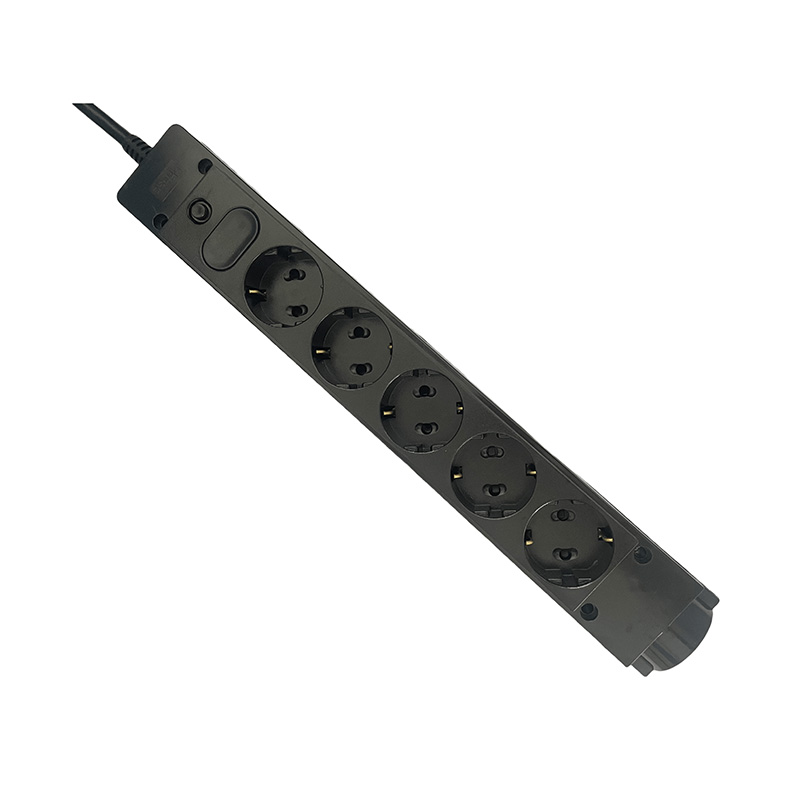
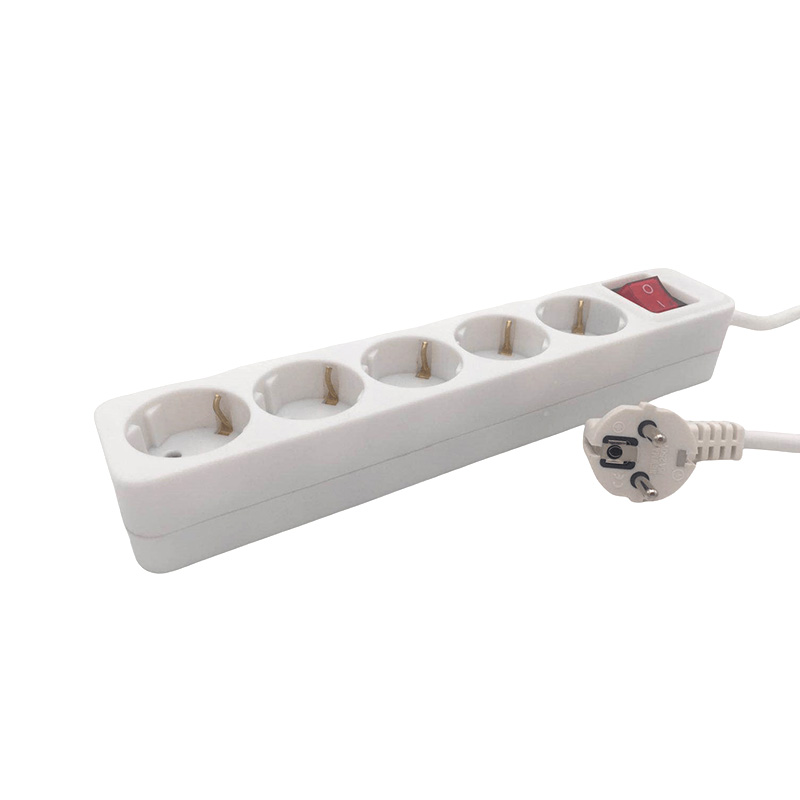
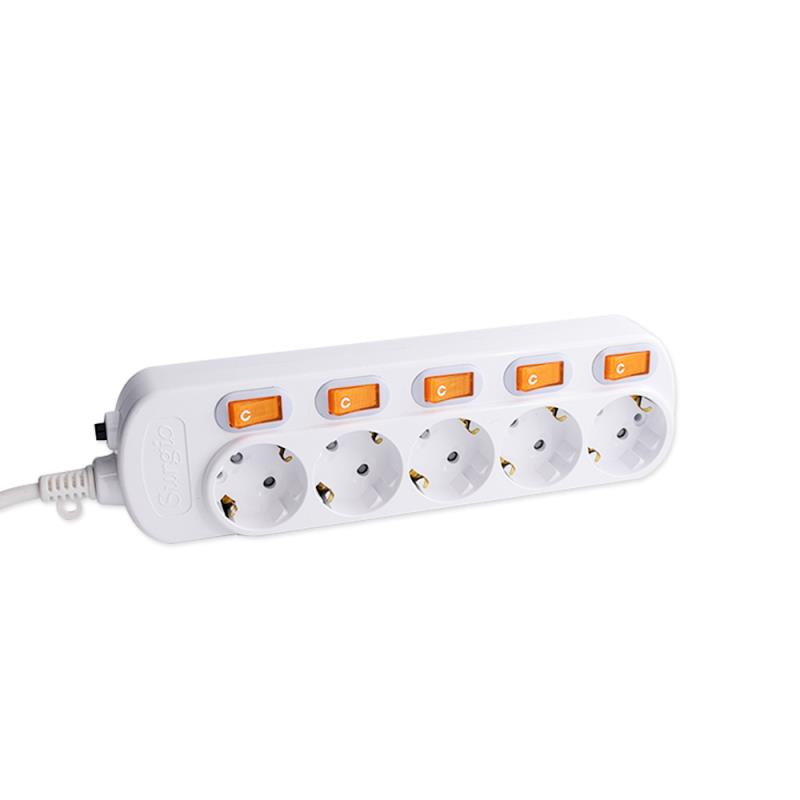
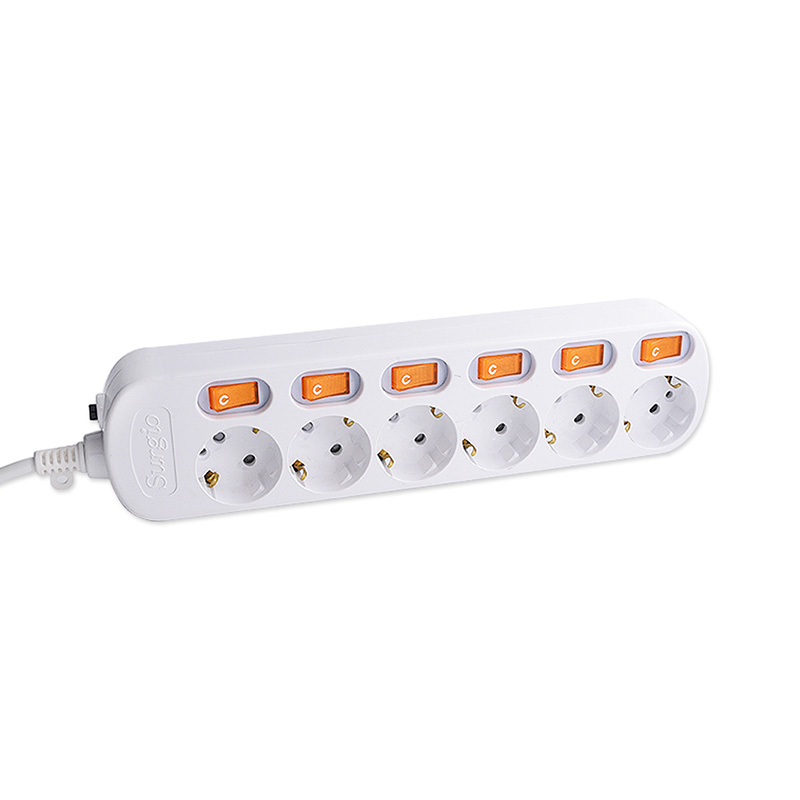
The protection should be a thermal-magnetic breaker or a thermal cutoff with a manual reset button, not a plain rocker switch labeled 'protection.' When current exceeds the rating, the breaker opens the circuit and disconnects all outlets. Once the load is removed, the user presses the button to restore power. For a desk or a workbench, a four-outlet strip with overload protection and a 16 AWG or 14 AWG cord covers most situations. If you are sourcing for an installation in a 230-volt market, a four-outlet EU standard power strip with overload protection gives you that reset capability in a PC material housing.
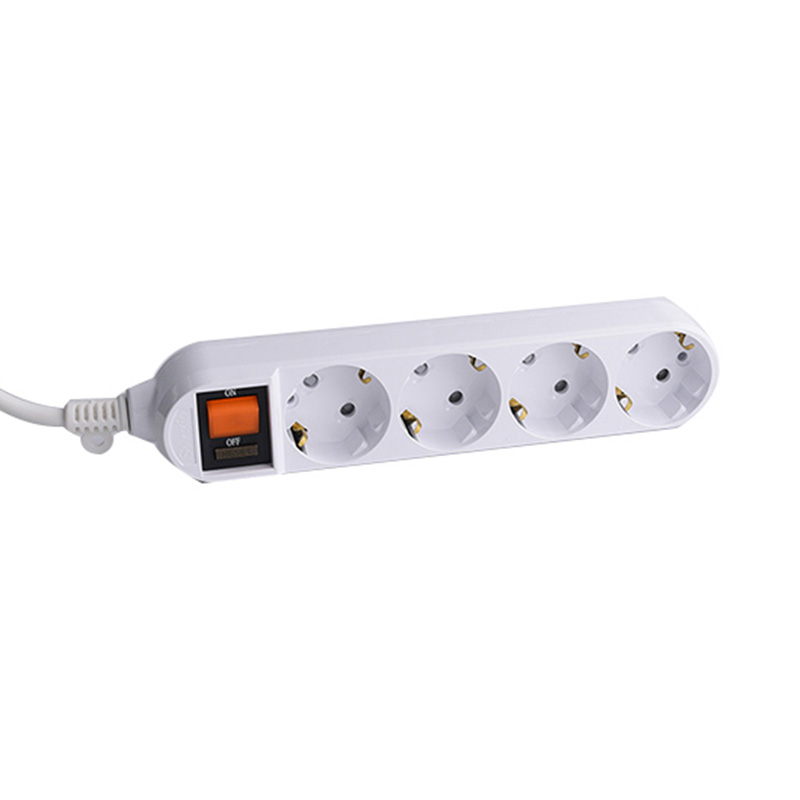 Custom Cable3G 4 outlets EU standard socket with overload protection switch ManuHangzhou Newmany is China Customized Cable3G 4 outlets EU standard socket with overload protection switch Manufacturers and Cable3G 4 out...View Product →
Housing material: PC versus PP
The housing is not cosmetic. It holds the sockets, absorbs heat, and contains any arc that might develop inside. Two plastic families dominate the industry: polycarbonate (PC) and polypropylene (PP).
PC offers higher heat resistance, better flame retardancy, and stronger impact performance. It is the usual choice for strips that run warm loads or sit in rooms where fire safety matters. The relationship between heat resistance, fire resistance, and flame retardancy in PC power strips is worth reading before you specify a product, because the three properties are often confused.
PP resists chemicals better and keeps its dimensions in humid or oily environments. It shows up in budget strips and in industrial settings where the housing may contact cleaning agents or lubricants. That chemical resistance has a measurable effect on how long the strip keeps its shape and socket grip, which is why PP chemical resistance and long-term durability deserve attention before you choose a material.
For a 15 ft strip that will be pulled, coiled, and occasionally stepped on, PC offers the better balance of stiffness and impact strength. For a strip that sits permanently in a clean, dry location, PP is a legitimate cost-saving choice.
USB ports and independent switches
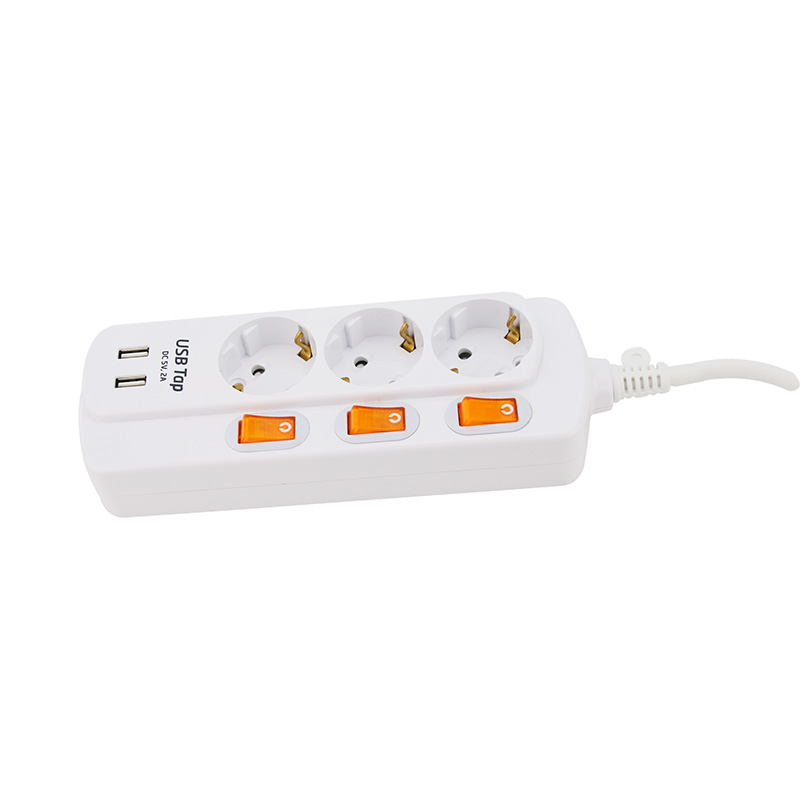
A long cord invites permanent placement, which often means the strip ends up behind furniture. If charging devices are part of the load, choose a model with USB ports and a master switch so you can cut standby power without unplugging the entire cord. A four-outlet EU standard socket with two USB ports and overload protection is a common configuration for desks and bedside setups.
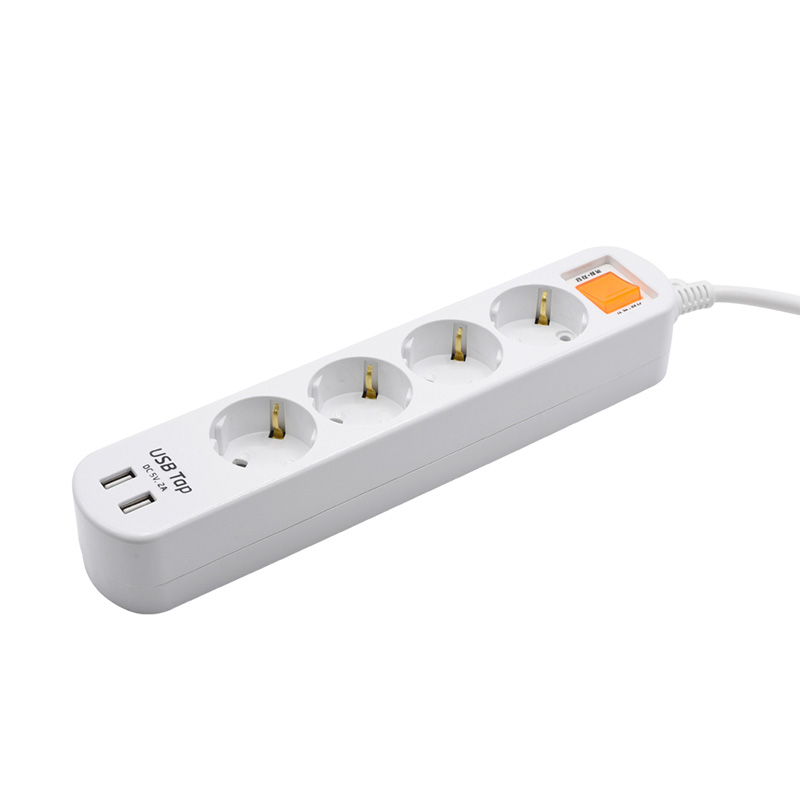 Custom Economical 4 outlets EU standard socket with 2 USB ports and 1 overload pHangzhou Newmany is China Customized Economical 4 outlets EU standard socket with 2 USB ports and 1 overload protection switch Manufactu...View Product →
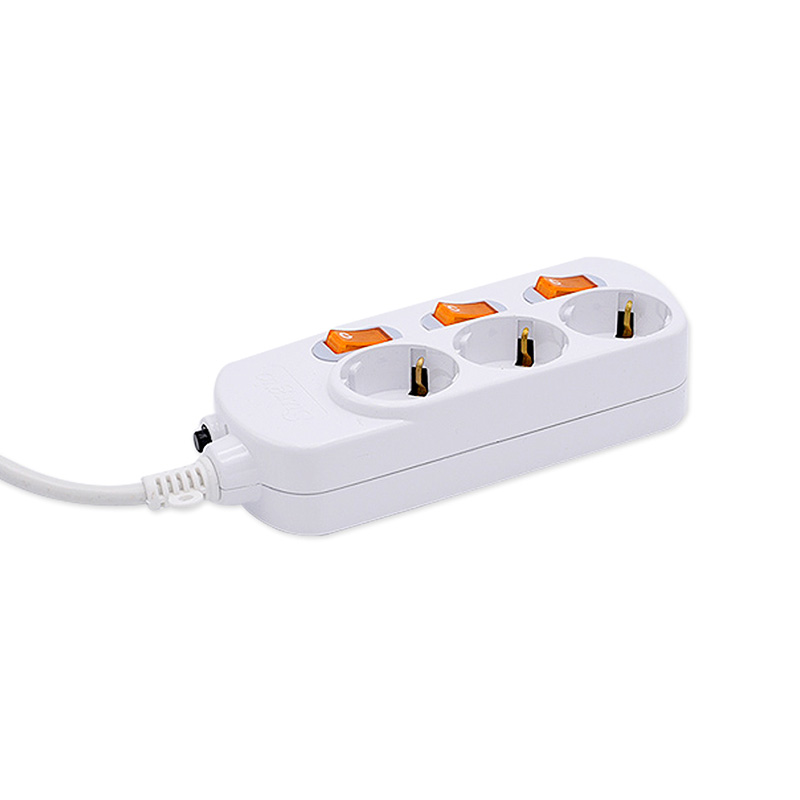
Independent switches on individual outlets add another layer of convenience. On a 15 ft strip they spare you from walking across the room every time one appliance needs to be powered down while the rest stay on.
Safety and standards you should not skip
A long power strip concentrates the risk of a long cable into one product. Standards and certifications are the only reliable proof that the design has been tested.
- Match the plug and socket standard to your market: EU (CEE 7), Korean (KC), or Chinese (GB). A product built for one standard should not be silently adapted to another.
- Confirm that the current rating of the cord matches the socket rating. A 16 A socket on a 10 A cord is a defect, not a feature.
- Look for certification marks from the destination market and for an ISO 9001 quality system covering the production line.
- Verify the grounding path. A three-conductor cord and a grounded plug protect connected equipment only if the wall outlet itself is grounded.
Manufacturers that follow international quality assurance systems tend to publish their standards openly. When a strip detects a fault, the correct response is automatic: trip the circuit, cut the load, and wait for a manual reset rather than cycling power endlessly. The protective measures a power strip takes after detecting a fault are a good indicator of design maturity.
Two operational rules keep a 15 ft strip safe in daily use. Do not connect two strips end to end; the second strip does not add protection, it only adds resistance and heat. Do not run the cord under a rug or through a doorway, where it can be damaged without being noticed.
When 15 feet still is not enough
Sometimes the measured distance is 25 feet, or the power source is outside, or the work area changes every week. In those cases, a fixed-length strip is the wrong tool. A cable reel provides the same outlets with the ability to adjust working length and store the cable when it is idle.
Reels are available in configurations rated for indoor and outdoor use, and the drum keeps the cord from tangling while lifting the socket block off damp ground. For a workshop, a garage, or a temporary event setup, a reel is often a better investment than a 15 ft strip. For buyers working to EU standards, EU standard cable reels for indoor and outdoor use cover exactly this class of applications.
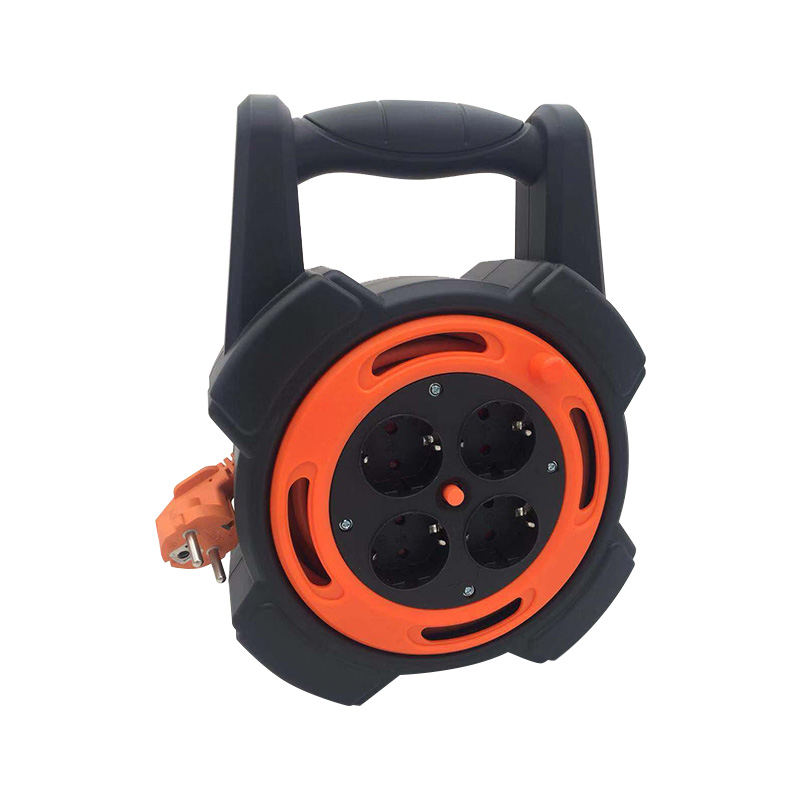 Custom EU standard Cable reels for indoor and outdoor use Manufacturers, SupplieHangzhou Newmany is China Customized EU standard Cable reels for indoor and outdoor use Manufacturers and EU standard Cable reels for ind...View Product →
Buying 15 ft power strips from a manufacturer
When you buy from a manufacturer instead of a retailer, the conversation changes. Packaging matters less than the specification sheet, and the questions become: what cord gauge will you fit, what breaker do you use, what material is the housing, and which standards does the finished product meet?
A manufacturer with its own tooling and assembly line can adjust cord length, socket count, switch configuration, and housing color to the buyer's requirements. The useful signal is whether the factory also controls quality: ISO 9001 certification, in-house testing of overload and temperature behavior, and a documented export history.
Look for a supplier that has been making plugs, sockets, and extension cords long enough to have encountered real failure modes. A company founded in 1989 that exports over five million overload protectors, switches, and converters per year and operates its own R&D center carries a different risk profile than a trading company that relabels imported goods.
The practical takeaway: a power strip 15 ft long is not a commodity item. The cord gauge, the breaker, the housing plastic, and the certifications decide whether it protects your equipment for years or becomes a hazard. Match those four elements to your load, and the long cord stops being a compromise and becomes a permanent part of the setup.
PRODUCTS
ABOUT US
CONTACT INFO.
- +86-18758062352
- +86-0571-64701616
- [email protected]
- No. 7, Xinqu Road, Xin’Anjiang Street, Jiande, Hangzhou, Zhejiang, China

Copyright © 2023 Hangzhou Newmany Electronics Co., Ltd. All Rights Reserved. Power Strip Manufacturer in China| Login

 TOP
TOP