
 ENG
ENG
 English
 русский
 한국어
한국어 Deutsch
Submit feedback
News

Do All Power Strips Have Surge Protection? The Full Breakdown
 2026.06.02
 Industry News
Content
- 1 The Direct Answer: No, Most Power Strips Do Not
- 2 What a Basic Power Strip Actually Does
- 3 What Surge Protection Really Means
- 4 Overload Protection vs Surge Protection: Not the Same Thing
- 5 Does a Power Switch Mean Surge Protection?
- 6 How to Tell If Your Power Strip Has Surge Protection
- 7 Which Devices Actually Need Surge Protection
- 8 Choosing the Right Power Strip for Your Needs
The Direct Answer: No, Most Power Strips Do Not
Not all power strips have surge protection — and the majority of basic models sold today offer none whatsoever. A standard power strip is, at its core, nothing more than a multi-outlet extension of your wall socket. It delivers electricity to whatever is plugged into it, but it does nothing to filter, limit, or divert the voltage your devices receive. If a surge arrives through the line, it passes straight through the strip and into every device connected to it.
The confusion is understandable. Power strips and surge protectors are sold side by side, often look identical, and are frequently marketed with overlapping language. A product described as offering "protection" may be referring to overload protection, circuit breaking, or child-safe shutters — none of which have anything to do with voltage surge suppression. Understanding the actual difference between these features is the most useful thing you can do before buying either product.
What a Basic Power Strip Actually Does
A basic power strip performs one function: it takes the single electrical outlet in your wall and multiplies it into several outlets you can use simultaneously. Inside the housing, the live, neutral, and earth wires from the mains connection run to each outlet socket in parallel. Every socket receives the same voltage as the wall outlet — no more, no less, and with no modification to the incoming signal.
Some basic power strips include a master on/off switch that cuts power to all outlets at once. Others include a thermal fuse or circuit breaker that trips if the total current draw across all outlets exceeds a rated threshold. These are useful features that prevent overheating and reduce fire risk, but neither of them constitutes surge protection. They respond to sustained overcurrent — too many devices drawing too much power at once — not to the brief, sharp voltage spikes that define an electrical surge.
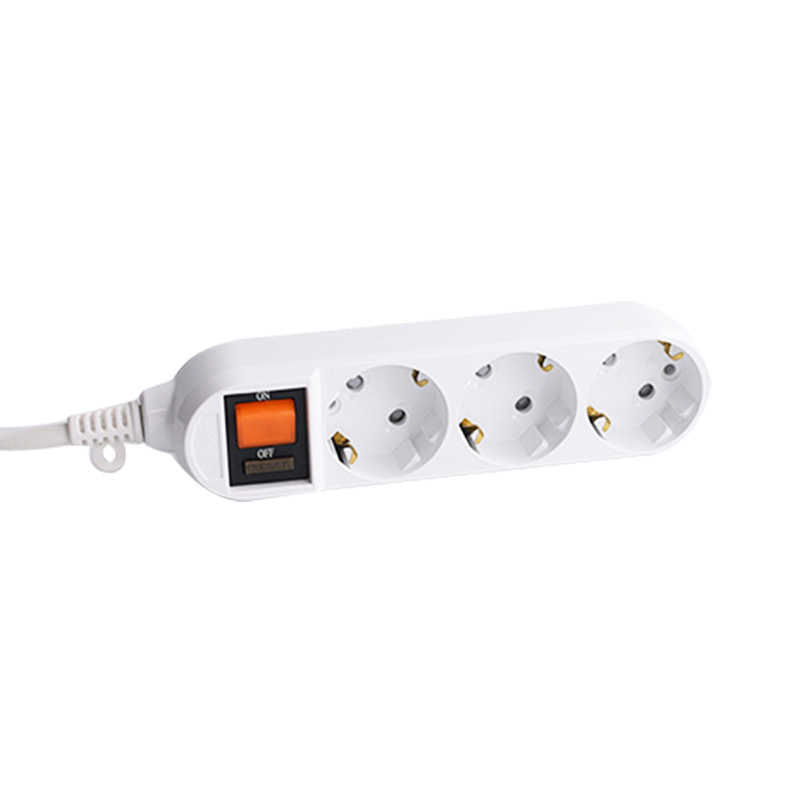
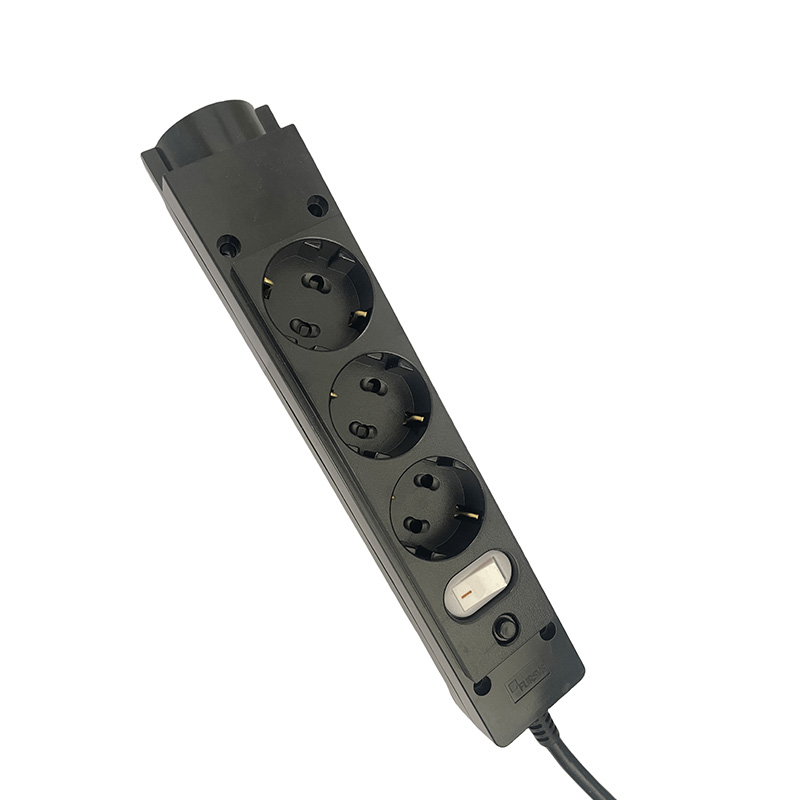
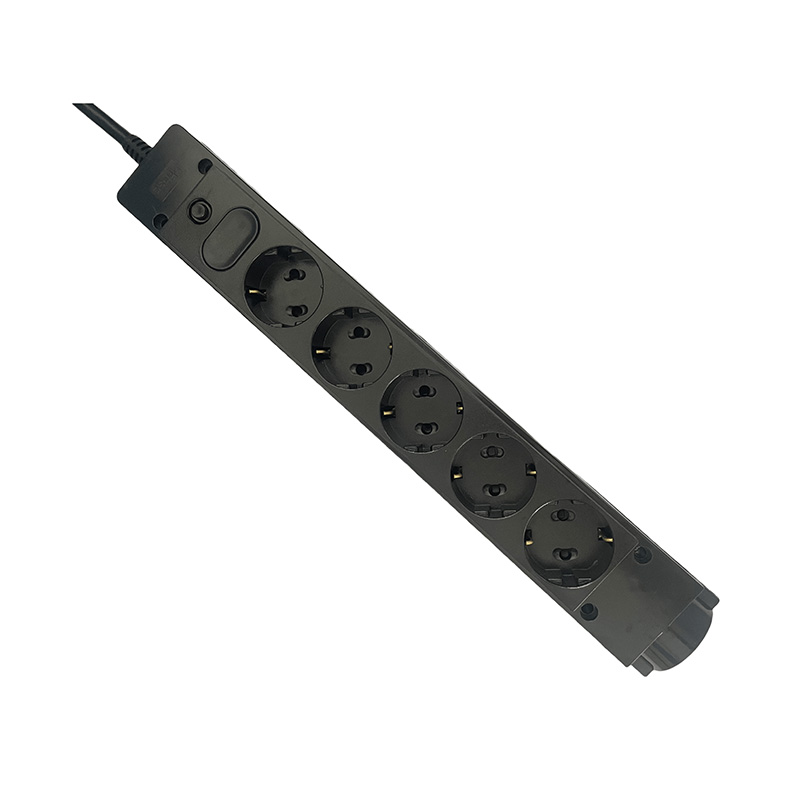
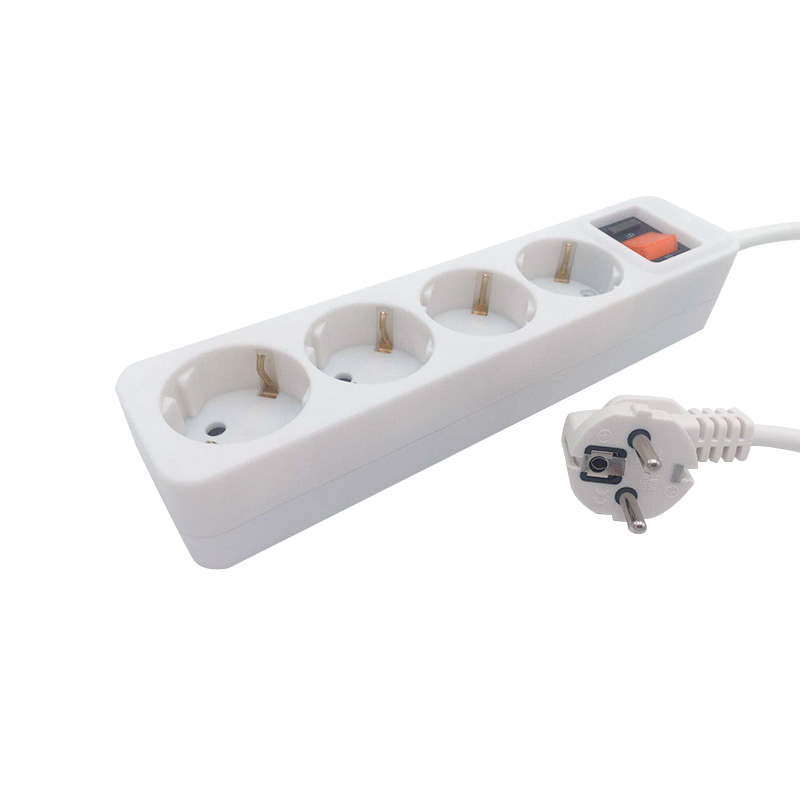
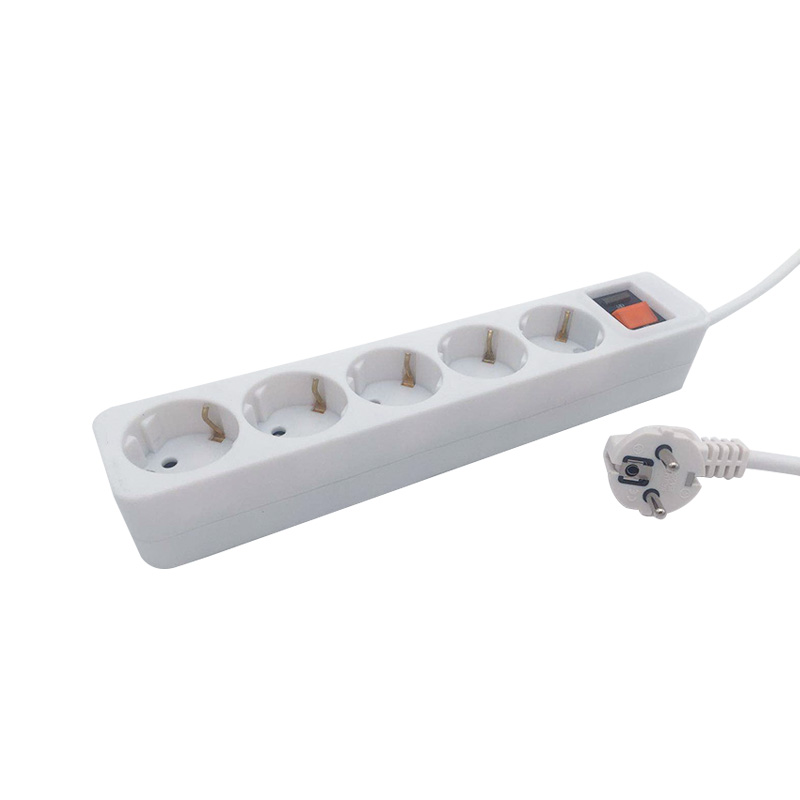
The full range of EU and KC standard power strips available for residential and commercial use spans a wide spectrum of configurations — outlet counts, cord lengths, switch arrangements, and housing materials — but the fundamental electrical function of a basic strip remains the same across all of them: pass-through power delivery with no active voltage management.
What Surge Protection Really Means
A genuine surge protector contains at least one additional component not found in a basic power strip: a Metal Oxide Varistor, or MOV. This small but critical component sits between the incoming power line and the outlets, monitoring the voltage constantly. Under normal conditions it remains inactive. When a voltage spike arrives — from a lightning strike nearby, a utility switching event, or a large motor cycling off — the MOV activates and diverts the excess energy away from the connected devices, typically routing it into the ground wire instead.
The capacity of a surge protector to absorb these events is measured in joules. A joule rating tells you how much total surge energy the device can absorb over its lifetime before the protection degrades. A 400-joule rating is minimal — adequate for very light-duty use. For computers, televisions, home theatre systems, and other sensitive electronics, a rating of 1,000 joules or above is the more appropriate starting point, with 2,000+ joules recommended for high-value equipment or areas with unstable grid supply.
The other key specification is clamping voltage — the level at which the MOV activates and begins diverting the surge. Lower clamping voltages offer better protection because the MOV intervenes earlier, before the spike reaches a level that could stress sensitive components. A clamping voltage of 330V or below is the standard benchmark to look for; anything higher means the surge has already climbed to a potentially damaging level before the protector responds.
It is also worth understanding that MOV-based protection is consumable. Every absorbed surge degrades the varistor slightly. A surge protector that has absorbed several large events may still power your devices normally but offer little remaining protection — which is why reputable models include an indicator light that confirms the protection circuit is still functional, and why replacing surge protectors every three to five years is good practice regardless of visible damage.
Overload Protection vs Surge Protection: Not the Same Thing
This is the point where the most significant consumer confusion occurs, and it is worth being precise. Overload protection and surge protection address two completely different electrical problems. Having one does not mean you have the other.
Overload protection — typically delivered through a built-in circuit breaker or thermal fuse — monitors the total current flowing through the strip. If the combined draw of all connected devices exceeds the strip's rated amperage, the breaker trips and cuts power. This prevents the wiring inside the strip from overheating, which could cause a fire. It is a valuable safety feature. It has no effect on voltage spikes, which happen in microseconds and involve voltage rather than sustained current.
Surge protection monitors voltage, not current. It activates in response to momentary spikes — events that may last less than a millisecond — and diverts the excess energy before it reaches connected devices. A strip with a circuit breaker but no MOV will cut power if you plug in too many high-draw appliances, but it will do nothing to protect a plugged-in laptop from a voltage spike caused by a nearby lightning strike.
Many well-designed power strips combine both features: a circuit breaker for sustained overcurrent protection and surge suppression components for transient voltage events. Understanding that these are separate systems helps you read product specifications accurately. When a product page describes power strips with overload protection switch, that language is describing the circuit-breaker function specifically — a meaningful safety feature, but not a claim of surge suppression. For a more detailed look at what a power strip's internal protection systems actually do when a fault is detected, how a power strip protects itself after detecting a fault breaks down the response mechanisms in practical terms.
Does a Power Switch Mean Surge Protection?
No — and this misconception is widespread enough to be worth addressing directly. A power switch on a strip, whether it is a single master switch or individual switches per outlet, controls whether electricity flows to the connected sockets. Switching an outlet off cuts power to whatever is plugged into it. That is the extent of what a switch does.
A switched outlet offers no filtering, clamping, or diversion of voltage. If the switch is on and a surge arrives, the surge travels through to the connected device exactly as it would through an unswitched socket. The only surge-protective effect a switch could theoretically provide is if the outlet is switched off entirely when a surge occurs — in which case there is no connected path for the surge to travel. But relying on a device being switched off as surge protection is not a protection strategy; it is simply the device not being in use.
Individual switched outlets do offer a genuine practical benefit: they allow you to cut power to specific devices independently without unplugging them, which reduces phantom load and makes it easier to power-cycle individual components. Power strips with individual switches are a useful feature for managing multiple devices efficiently — just not a substitute for actual surge suppression circuitry.
How to Tell If Your Power Strip Has Surge Protection
The distinction between a surge protector and a basic power strip is not always obvious from the physical product, but the packaging and labeling provide clear signals if you know what to look for.
Check for explicit surge language. A genuine surge protector will state "surge protection," "surge suppressor," or "surge protector" prominently on the packaging or the device itself. Generic terms like "protection," "safety switch," or "overload protected" do not confirm surge suppression. If the word "surge" does not appear, assume the product does not offer it.
Look for a joule rating. Any product with a stated joule rating — 600J, 1080J, 2000J — contains surge suppression components. The joule rating is only meaningful in the context of MOV-based protection; a basic power strip has no joule value to declare because it has no energy-absorbing component.
Look for a "Protected" indicator light. Most surge protectors include a small indicator light labeled "Protected" or "Surge Protection." When this light is illuminated, the MOV is functional. If the light goes out while the strip is still powering devices, it signals that the protective components have been exhausted and the product should be replaced.
Check for UL 1449 certification. In the United States, UL 1449 is the safety standard specifically for surge protective devices. A product certified to UL 1449 has been independently tested to confirm it meets defined surge suppression performance thresholds. No equivalent certification exists for basic power strips because there is no surge performance to certify. In European markets, look for EN 61643-11 compliance for equivalent confirmation.
| Feature | Basic Power Strip | Surge Protector |
|---|---|---|
| Surge / MOV component | No | Yes |
| Joule rating stated | No | Yes (look for 1,000J+) |
| "Protected" indicator light | No | Yes (on quality models) |
| UL 1449 / EN 61643-11 certification | No | Yes |
| Overload / circuit breaker | Sometimes | Often included alongside surge protection |
| Master or individual switches | Sometimes | Sometimes — unrelated to surge protection |
Which Devices Actually Need Surge Protection
Not every device in your home carries the same risk exposure or the same replacement cost if damaged. Prioritizing surge protection for high-value, sensitive electronics makes practical sense; accepting the risk for simpler appliances is a reasonable cost-benefit decision for most households.
Always protect: desktop computers and laptops, monitors and displays, televisions, home theatre receivers and amplifiers, network routers and modems, NAS drives and external storage, gaming consoles, and any device with an internal power supply that processes digital signals. These combine high replacement cost with sensitivity to voltage irregularities — the worst possible combination for an unprotected surge event.
Consider protecting: smart home hubs, CCTV recorders, medical devices such as CPAP machines, and high-end kitchen appliances with digital controls. Their internal electronics are vulnerable even if the device itself appears robust.
Lower priority: lamps, fans, basic power tools, and appliances with simple resistive or inductive loads (toasters, kettles, hair dryers). These devices have no sensitive circuitry to protect, and a surge large enough to damage them would typically be severe enough to cause wider electrical damage regardless of what protection was in place.
Choosing the Right Power Strip for Your Needs
Once you understand the distinction between basic strips and surge protectors, the buying decision becomes a straightforward matching exercise between your actual requirements and the product specifications.
For workstations, entertainment centers, and any area where multiple sensitive devices are grouped together, a surge protector with a joule rating of at least 1,000J, a confirmed "Protected" indicator light, and individual switched outlets for device management is the appropriate choice. The small price premium over a basic strip is negligible compared to the replacement cost of a single damaged laptop or television.
For utility areas — charging stations for low-value devices, powering lamps and fans, running basic appliances — a quality basic power strip with overload protection is a practical and cost-appropriate solution. The key here is build quality: a strip that maintains solid electrical connections, uses appropriately rated wiring, and is constructed from materials that resist heat and maintain dimensional stability over years of use. The housing material matters more than it might appear, and understanding how polypropylene affects the long-term durability of power strips helps explain why the choice of housing material is a genuine performance factor, not just an aesthetic one.
Whatever product you choose, avoid purchasing power strips solely on the basis of price. Low-cost strips with no independent safety certification carry real risks — not because they lack surge protection, but because they may use undersized internal wiring, low-quality contacts, or housings that soften under sustained heat. A power strip that fails under load is more dangerous than one that simply lacks surge suppression. Certified construction quality and appropriate load ratings are the baseline requirements; surge protection is the additional layer for environments where sensitive electronics need it.


PRODUCTS
ABOUT US
CONTACT INFO.
- +86-18758062352
- +86-0571-64701616
- [email protected]
- No. 7, Xinqu Road, Xin’Anjiang Street, Jiande, Hangzhou, Zhejiang, China

Copyright © 2023 Hangzhou Newmany Electronics Co., Ltd. All Rights Reserved. Power Strip Manufacturer in China| Login

 TOP
TOP