
 ENG
ENG
 English
 русский
 한국어
한국어 Deutsch
Submit feedback
News

Power Strip 4 Outlets: What to Look For and Why It Matters in 2026
 2026.06.08
 Industry News
Why the 4-Outlet Power Strip Is Having a Market Moment
The global power strip and surge protector market continues to expand steadily, driven by the rising number of powered devices in every home, office, and workspace. The average household in a developed economy now runs more than ten devices that require regular charging or continuous power—laptops, monitors, phones, tablets, smart speakers, routers, gaming consoles, and a growing list of USB-powered accessories. Against that backdrop, the single wall outlet has become structurally inadequate, and the power strip is no longer a convenience accessory. It is a foundational piece of electrical infrastructure.
Among the range of formats available, the 4-outlet power strip occupies a particularly practical position. It is large enough to handle a complete desk setup or bedside charging station without exceeding the safe continuous load limits that single-circuit residential wiring is designed to carry. It is compact enough for travel, desk mounting, and under-furniture installation. And it is the format around which the most significant product innovation—USB integration, surge protection, flat-plug design, individual switched outlets—has been concentrated in recent years. Understanding what separates a reliable 4-outlet power strip from a substandard one is increasingly a question of household electrical safety, not just product preference.
Content
What "4 Outlets" Means—and Why That Number Works
A 4-outlet power strip provides four standard AC receptacles fed from a single input plug, allowing four separate devices to draw power from one wall socket simultaneously. The critical constraint governing safe use is the total power draw across all four outlets relative to the circuit's rated capacity.
Most residential circuits in North America are rated at 15 amperes at 120 volts, yielding a theoretical maximum of 1,800 watts per circuit. Standard electrical safety guidance recommends loading a circuit to no more than 80% of its rated capacity for continuous operation—approximately 1,440 watts in a 15-amp circuit. A 4-outlet strip serving a typical home office setup—laptop (65W), monitor (40W), desk lamp (10W), and phone charger (20W)—draws a combined 135 watts, well within safe limits. The same strip plugged into a space heater (1,500W) alongside any other device immediately approaches or exceeds circuit capacity.
Four outlets also aligns with the way most people actually organize powered spaces. A bedside setup typically needs two to four outlets: a lamp, a phone charger, a tablet or e-reader charger, and perhaps a white noise machine or CPAP device. A home office desk requires outlets for a computer, monitor, USB hub, and desk light. A living room entertainment center needs outlets for a television, streaming device, soundbar, and gaming console. In each case, four outlets covers the practical requirement without encouraging the daisy-chaining of multiple strips—a practice that bypasses circuit protection and is a documented cause of residential electrical fires.
Surge Protection vs. Basic Power Strips: The Distinction That Matters
Not all power strips include surge protection, and the difference is consequential for anyone using the strip to power electronics with sensitive internal components.
A basic power strip is a passive device. It distributes power from the wall outlet to multiple receptacles and typically includes a circuit breaker that trips if the total load exceeds the strip's rated amperage. It does nothing to filter or limit voltage spikes—sudden brief increases in line voltage caused by lightning strikes, utility switching events, or large appliances cycling on and off. These spikes can damage or degrade semiconductors, storage devices, and power supplies in computers, televisions, audio equipment, and smart home devices.
A surge-protected power strip adds metal oxide varistors (MOVs) to the circuit. MOVs are voltage-sensitive components that conduct electricity—and divert excess energy to the ground wire—when voltage rises above a threshold. The protection capacity is measured in joules: the total energy the MOVs can absorb before they are depleted. A 4-outlet strip with 900 to 1,080 joules of surge protection provides adequate coverage for standard consumer electronics. Models rated at 1,500 joules and above are appropriate for high-value equipment and markets with less stable grid power.
One important clarification: MOVs deplete with use. A surge protector that has absorbed significant cumulative surge energy may show no visible sign of failure while providing progressively less protection. Quality surge-protected strips include an indicator light that signals when the MOV protection has been exhausted—a feature worth prioritizing when evaluating 4-outlet models. Once the indicator shows protection failure, the strip continues to function as a basic power distributor but no longer protects against voltage events.
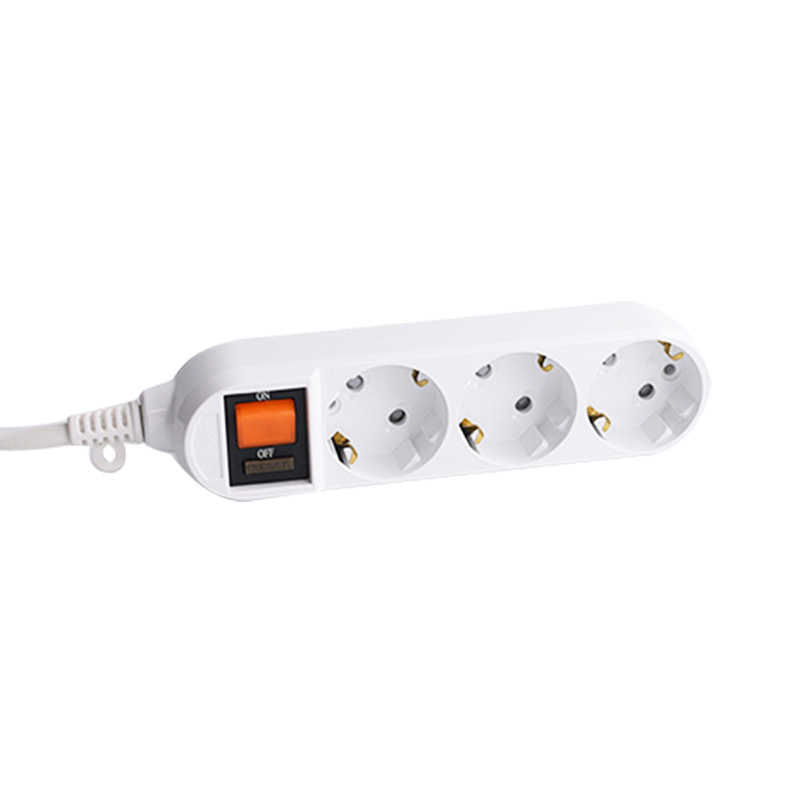
Safety Certifications Every Power Strip Should Carry
The safety profile of a power strip is only as reliable as the testing and certification that backs it. In the consumer market, two independent certification marks provide meaningful assurance of compliance with established electrical safety standards.
UL Listed (Underwriters Laboratories) means the product has been tested by UL, an independent safety certification organization, and found to meet the applicable standards for its product category. For power strips, the relevant standard is UL 1363 (Relocatable Power Taps). UL listing is not self-certified: manufacturers submit products for testing, and listed status must be maintained through ongoing production monitoring. The full scope of UL's power strip and surge protector testing standards is documented through their official resources, which serve as the technical baseline for North American market compliance. the Tripp Lite / Eaton power strip buying guide offers a useful overview of how these specifications translate to product selection decisions.
ETL Listed is the equivalent certification from Intertek, another accredited independent testing laboratory. ETL and UL marks carry equal regulatory weight for North American market access—a product bearing either mark has been tested to the same underlying ANSI/UL standard. Some manufacturers pursue both certifications; either one is sufficient evidence of baseline safety compliance.
Beyond the primary listing mark, several additional safety features indicate a well-engineered product. Flame-retardant housing—typically ABS plastic rated UL 94V-0—resists ignition and limits flame spread in the event of an internal fault. Child-safety shutters on outlet slots prevent objects from being inserted into live contacts. Overload protection with automatic reset trips a thermal circuit breaker when total load exceeds the strip's rated capacity and allows manual reset once the fault is cleared, rather than requiring fuse replacement. All three features should be considered baseline requirements for any power strip used in a home with children or in commercial environments.
USB Integration: How 4-Outlet Strips Have Evolved
The most significant product development in the consumer power strip category over the past decade has been the integration of USB charging ports alongside standard AC outlets. A 4-outlet power strip with USB ports effectively extends the device count the strip can serve—each USB port handles a charging device without occupying an AC outlet, leaving all four receptacles available for AC-powered equipment.
Current market-leading 4-outlet models typically combine four AC outlets with two to four USB ports, in configurations that increasingly include at least one USB-C Power Delivery (PD) port. USB-C PD changes the utility of the strip meaningfully: a port rated at 45W or above can charge a laptop at full speed, which was not possible with earlier USB-A ports limited to 5W to 12W output. For users with MacBooks, iPads Pro, or Android flagships—all of which charge via USB-C—a 4-outlet strip with a USB-C PD port eliminates the need for a separate laptop charger adapter, freeing an AC outlet for another device.
When evaluating USB specifications on a 4-outlet strip, the critical detail is whether the USB ports share total wattage or provide dedicated per-port power. A strip rated at "4 USB ports, 5A total" distributes 5 amps across all four ports simultaneously, meaning four devices charging at once each receive approximately 1.25A—adequate for phones but insufficient for tablets or laptops. A strip with dedicated per-port ratings—for example, "USB-C: 45W, USB-A: 12W each"—provides consistent charging speed regardless of how many ports are in simultaneous use.
Choosing the Right 4-Outlet Power Strip for Your Setup
The right 4-outlet power strip for a given application is defined by the combination of outlet count, surge protection rating, USB specifications, cord length, and physical form factor that matches the installation context. Several scenarios illustrate how these variables interact.
Home office and desk setups. The priority is outlet spacing and USB-C availability. Wide-spaced outlets—1.78 inches or more between centers—accommodate large wall-wart power adapters without blocking adjacent receptacles. A USB-C PD port at 45W or above handles laptop charging. Flat-plug design (right-angle plug) allows placement close behind furniture without pulling the cord away from the wall. A cord length of 5 to 6 feet provides placement flexibility for most desk configurations.
Bedside and nightstand use. Compact form factor and individual outlet switches are the key requirements. Individual switches allow the user to cut power to a lamp or fan without unplugging—relevant for energy management and device protection. A short cord (3 feet) keeps the installation tidy. USB-A and USB-C ports for overnight phone and tablet charging eliminate the need for separate plug adapters.
Travel and portable use. Weight, plug profile, and cord retractability or manageability determine fitness for travel. A 4-outlet strip in a compact housing with a flat plug and braided cord is easier to pack and less prone to cable damage than a bulky strip with a round cord. International travelers should verify the input voltage range: strips rated 100–240V accept the full range of global grid voltages without a separate adapter. Surge protection is particularly valuable for travel use in markets with variable grid stability.
Workshop and utility use. Heavy-gauge wiring (14 AWG rather than 16 AWG) and a higher amperage rating (15A rather than 10A) are the priorities. A longer cord (6 to 10 feet) provides reach in workshop configurations. Surge protection is less critical for power tools but the circuit breaker is essential—workshops often run high-draw equipment intermittently, and automatic overload cutoff prevents cable overheating.
Across all use cases, the one consistent requirement is that the strip's total rated wattage must comfortably exceed the combined continuous draw of everything plugged into it. Calculating that draw before purchase—adding up the wattage figures from each device's power label—takes under two minutes and is the most reliable way to avoid operating a power strip at or near its limits. A strip run consistently at 90% of its rated capacity runs hotter, ages faster, and presents a meaningfully higher risk than one sized with appropriate headroom. The 4-outlet format, chosen correctly for the load it will serve, remains one of the most cost-effective and practical electrical tools available for modern homes and workspaces.


PRODUCTS
ABOUT US
CONTACT INFO.
- +86-18758062352
- +86-0571-64701616
- [email protected]
- No. 7, Xinqu Road, Xin’Anjiang Street, Jiande, Hangzhou, Zhejiang, China

Copyright © 2023 Hangzhou Newmany Electronics Co., Ltd. All Rights Reserved. Power Strip Manufacturer in China| Login

 TOP
TOP