
 ENG
ENG
 English
 русский
 한국어
한국어 Deutsch
Submit feedback
News
 Home / News / Industry News / Power Strip with Light vs Surge Protector vs Extension Cord: What You Need to Know
 Power Strip with Light vs Surge Protector vs Extension Cord: What You Need to Know
 2026.03.24
 Industry News
Power strips, surge protectors, and extension cords are among the most commonly used electrical accessories in homes, offices, and workshops — yet they are also among the most commonly misunderstood. Choosing the wrong type for the wrong application is one of the leading causes of electrical overloads and residential fires. Understanding exactly what each device does, how to read its indicator lights, and when to use it is essential for both safety and the protection of connected electronics.
Content
- 1 Power Strip with Light: What the Indicator Tells You
- 2 Power Strip vs Surge Protector vs Extension Cord: Core Differences
- 3 Extension Cord: Reach Without Protection
- 4 Power Strip: Outlet Expansion Without Surge Defense
- 5 Surge Protector: How It Works and When It Wears Out
- 6 Common Misuse and Safety Hazards
Power Strip with Light: What the Indicator Tells You
A power strip with a built-in indicator light is one of the most useful features to look for when purchasing. The light serves two distinct purposes depending on the type of strip:
- Power-on indicator: On basic power strips without surge protection, a neon or LED light simply shows that the strip is receiving power and the switch is in the on position. This light offers no information about protection status.
- Surge protection status indicator: On surge-protected strips, a dedicated "Protected" or "Surge" light shows whether the internal protection circuitry is still functional. A green light means devices are protected; a red or unlit light means the protection has been depleted and the strip should be replaced, even if it still delivers power normally.
This distinction is critical. A surge protector that has absorbed one or more large voltage spikes may continue to function as a basic power strip while providing no surge protection whatsoever — a condition known as silent degradation. The protection status light is the primary way users can detect this failure without specialized equipment.
Some advanced models include additional indicator lights beyond the basic power and protection indicators. These may include a grounding status light — which confirms the wall outlet the strip is plugged into is properly grounded — and per-outlet LED indicators that show whether individual sockets are receiving power. Higher-end smart strips now incorporate app-based alerts that notify users when surge protection capacity has been exhausted, replacing or supplementing the physical indicator light.
One important caveat: some low-quality manufacturers have been found to install indicator lights labeled "surge" that are simply wired to the power circuit and remain on whenever the strip is energized, regardless of actual protection status. The only reliable way to verify genuine surge protection is to confirm the presence of a UL 1449 certification mark and a stated joule rating on the packaging or unit label.
Power Strip vs Surge Protector vs Extension Cord: Core Differences
These three devices look similar and are often sold in the same aisle, but they serve fundamentally different purposes. Using the wrong one in the wrong context creates both safety risks and inadequate protection for connected devices.
| Feature | Extension Cord | Power Strip | Surge Protector |
|---|---|---|---|
| Primary function | Extends reach of a single outlet | Adds multiple outlets | Adds outlets + protects from voltage spikes |
| Surge protection | No | No | Yes |
| Joule rating | None | None | Typically 400–3,000+ joules |
| Circuit breaker | Rarely | Often included | Usually included |
| Indicator light | No | Power-on only | Power-on + protection status |
| Intended use | Temporary, single device | Multiple low-sensitivity devices | Electronics, computers, AV equipment |
| Key certification | UL 817 | UL 1363 | UL 1449 |
Extension Cord: Reach Without Protection
An extension cord is designed for one purpose: to extend the physical reach of a wall outlet, typically to a single device. It provides no overload protection, no surge suppression, and no additional outlets beyond the one or two at its end. Extension cords are rated by wire gauge (AWG) — a lower AWG number means a thicker wire capable of handling higher amperage loads.
Extension cords are appropriate for temporary use only. OSHA guidelines explicitly prohibit using extension cords as permanent wiring solutions. They should never be run under rugs, through walls, or across doorways — all of which damage insulation and create fire hazards. For sustained, multi-device use, a power strip or surge protector is the correct replacement. Extension cords should not be daisy-chained together under any circumstances, as this can overload the original cord and the wall circuit simultaneously.
Power Strip: Outlet Expansion Without Surge Defense
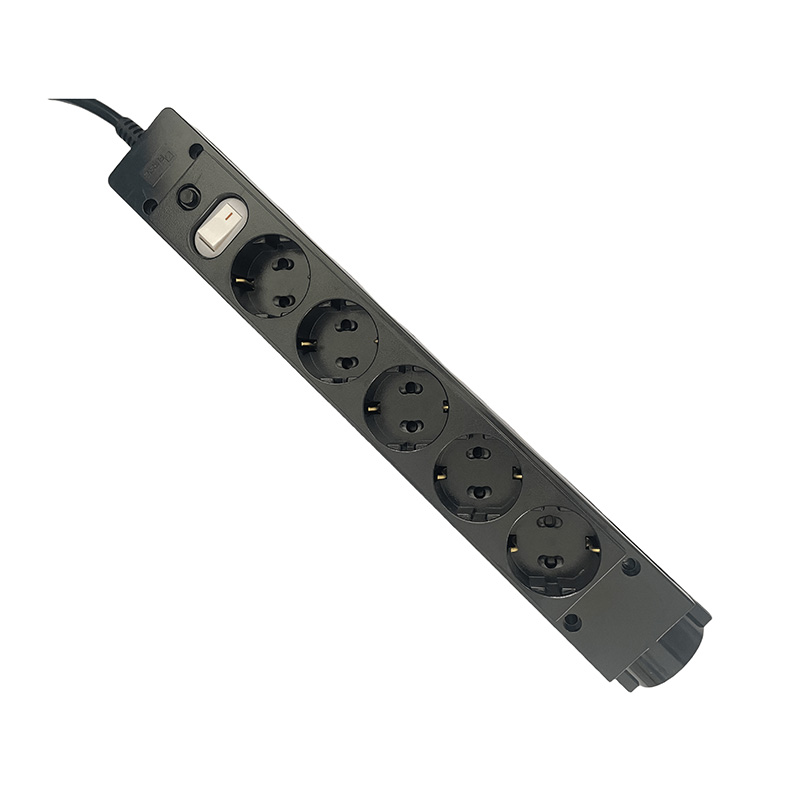
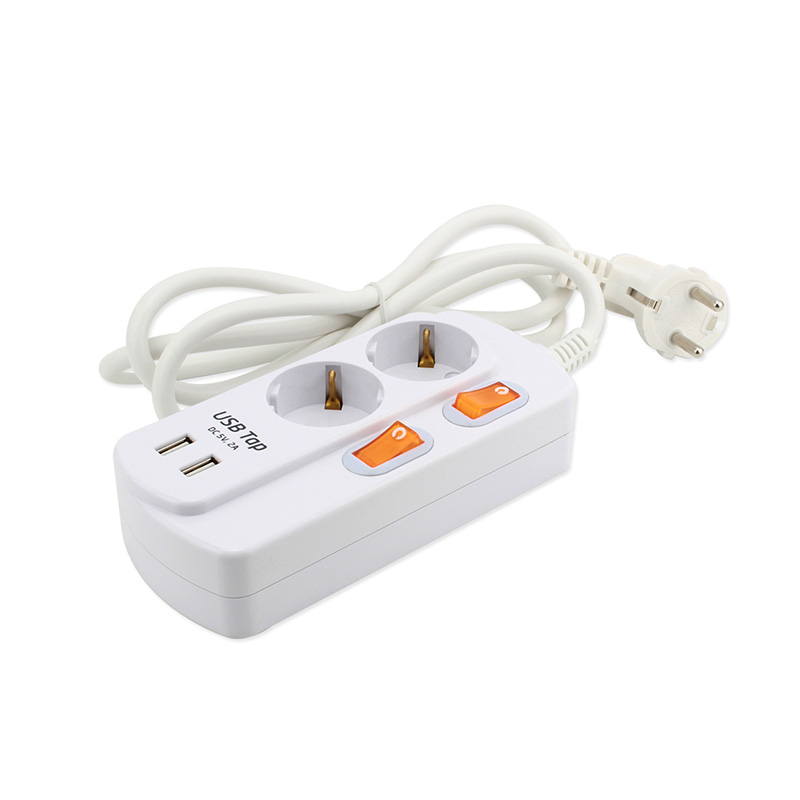
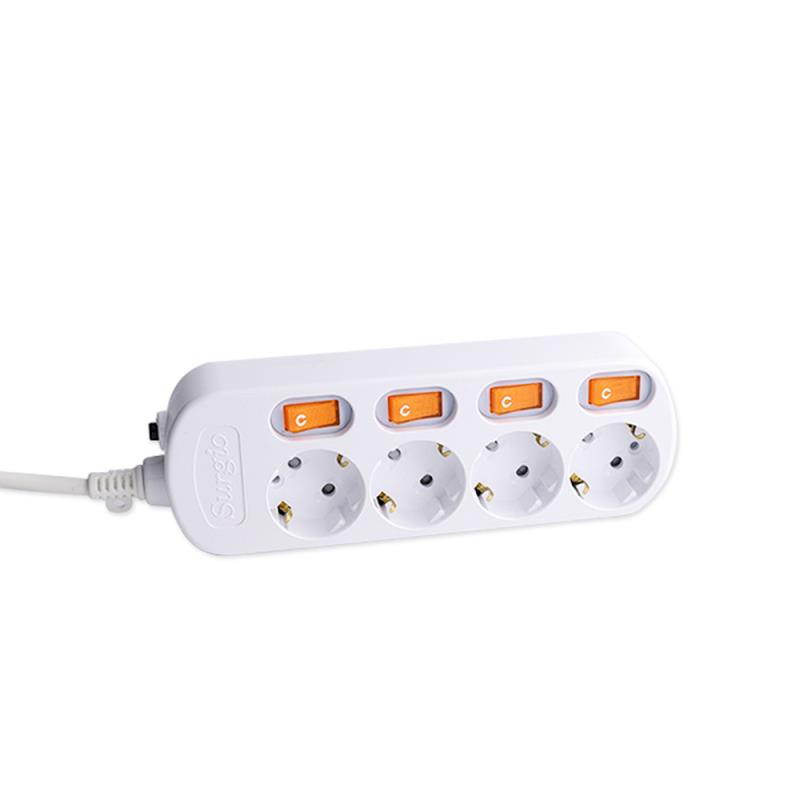
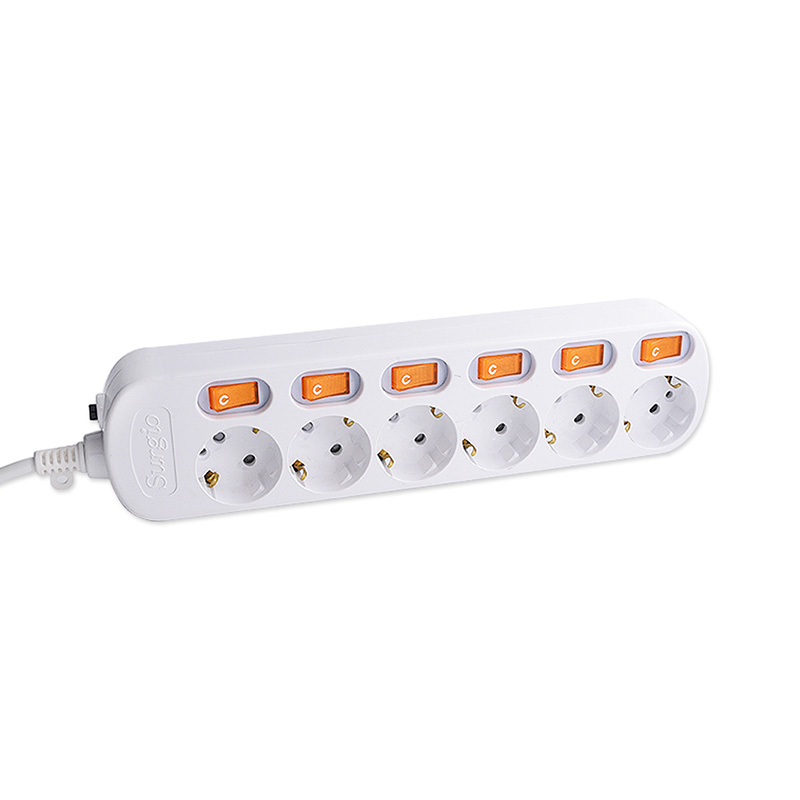
A power strip is essentially an extension cord with multiple outlets built into a housing, usually accompanied by an on/off switch and an integrated circuit breaker. The circuit breaker protects against overload — it trips and cuts power if the total load on the strip exceeds its rated amperage. What it does not do is protect against voltage spikes.
Power strips are appropriate for devices that are not sensitive to voltage fluctuations: lamps, fans, phone chargers, and similar low-sensitivity loads. They should not be used for computers, televisions, gaming consoles, home theater systems, or any device where a voltage spike could cause data loss or hardware damage. The power-on indicator light found on most power strips only confirms that power is present — it says nothing about protection from electrical faults.
Surge Protector: How It Works and When It Wears Out
A surge protector adds a layer of voltage spike suppression to the basic functionality of a power strip. Most consumer-grade surge protectors achieve this through components called Metal Oxide Varistors (MOVs), which absorb excess voltage and divert it away from connected devices. Each time an MOV absorbs a surge, it degrades slightly — and after absorbing enough cumulative energy (measured in joules), it loses its protective capacity entirely.
The joule rating of a surge protector indicates how much total surge energy it can absorb before its MOVs fail. For sensitive electronics such as computers and home theater systems, a minimum rating of 1,000 joules is recommended; 2,000 joules or more is preferred for high-value equipment. A rating below 400 joules provides only marginal protection and is generally not worth the investment for electronics protection.
Beyond joule rating, the clamping voltage — the threshold at which the surge protector activates — is a critical but often overlooked specification. A lower clamping voltage means the device responds to smaller spikes, providing tighter protection. The UL 1449 standard recognizes three clamping voltage levels: 330V, 400V, and 500V. For computer and AV equipment, 330V is the preferred rating.
Replacing a Surge Protector
Unlike a circuit breaker that can be reset, a surge protector's MOVs cannot be restored after they have fully degraded. A unit that has experienced a major surge event — or that shows a red or unlit protection indicator light — should be replaced immediately. As a general guideline, even without visible indicator warnings, surge protectors used in areas prone to frequent voltage fluctuations should be replaced every two to three years. Units used in areas with stable power grids and no major surge events may last longer, but the protection status light remains the most reliable day-to-day check.
Common Misuse and Safety Hazards
Despite their widespread use, power strips and surge protectors are frequently used in ways that create genuine fire and electrical hazards. The most common misuse patterns include:
- Daisy-chaining: Connecting one power strip or extension cord into another multiplies the overload risk and is prohibited by OSHA guidelines for workplace settings. The same risk applies in residential use.
- Plugging high-draw appliances into a power strip: Space heaters, microwaves, refrigerators, and air conditioners draw sustained high currents that exceed the safe operating load of most power strips. These devices should always be plugged directly into a dedicated wall outlet.
- Concealing cords under rugs or furniture: This traps heat generated by current flow, damages insulation over time, and significantly increases fire risk.
- Using indoor-rated strips outdoors or in damp areas: Moisture and indoor electrical components are fundamentally incompatible. Outdoor use requires specifically rated weatherproof products.
- Ignoring a tripped circuit breaker or overheating strip: A strip that feels warm to the touch, emits a buzzing sound, or trips its breaker repeatedly is operating beyond its safe capacity and should be unloaded immediately.
For installations requiring permanent multi-outlet capacity — in a home office, media room, or workshop — the appropriate long-term solution is having a licensed electrician install additional dedicated wall outlets rather than relying on any form of portable power distribution device as a permanent fixture.

PRODUCTS
ABOUT US
CONTACT INFO.
- +86-18758062352
- +86-0571-64701616
- [email protected]
- No. 7, Xinqu Road, Xin’Anjiang Street, Jiande, Hangzhou, Zhejiang, China

Copyright © 2023 Hangzhou Newmany Electronics Co., Ltd. All Rights Reserved. Power Strip Manufacturer in China| Login

 TOP
TOP