
 ENG
 English
 русский
 한국어
 Deutsch

Submit feedback
News
 Home / News / Industry News / IEC C13 Socket Guide: Ratings, Compatibility, and Safe Equipment Matching
IEC C13 Socket Guide: Ratings, Compatibility, and Safe Equipment Matching
 2026.11.02
 Industry News
A technician reaches into a bin of power cords, picks one with the familiar rectangular female end, and connects a monitor. The fit feels right, but the cord is rated for 70 C while the enclosure behind the monitor runs hotter. That is the everyday risk with a C13 socket: the interface is standardized, but the assembly around it is not. A C13 socket is a 10 A, 250 V IEC 60320 connector. Its safe use depends on temperature rating, cord gauge, plug type, approvals, and the inlet it is meant to mate with.
For buyers, the practical question is not “Is this a C13?” but “Is this C13 assembly correct for this load, this environment, and this market?” The answers usually come from the equipment label, the cord drawing, and the approval file rather than from the connector shape alone.
Content
What a C13 Socket Actually Standardizes
The C13 socket is the female half of the IEC 60320 C13/C14 pair. It has three pins in a rectangular housing and mates with a C14 inlet on equipment. It is not a wall plug. A complete C13 cord set combines a country-specific plug, a flexible cord, and the C13 connector. That split matters for sourcing: the connector can stay the same across markets while the plug end changes.
The standard rating is 10 A at 250 V. Many cords are sold as “10 A” and then used on 6 A or 8 A loads without issue. The risk appears when a 10 A connector is asked to carry a continuous load in a hot cabinet, or when a thin cord is used at length. The C13 shape does not guarantee conductor size, temperature rating, or strain-relief quality. Those are assembly decisions.
A common mistake is treating C13 and C19 as interchangeable because both are rectangular. They are not. C19 is larger, rated 16 A, and mates with C20. A C13 cord will not seat in a C20 inlet, and a C19 cord will not fit a C14 inlet. Specifiers should record the inlet type on the equipment, not just the cord end they see in a photo.
Ratings, Heat, and the C15 Trap
Standard C13 connectors are typically rated to 70 C. That is adequate for office equipment, but not for every appliance or enclosure. The C15 connector uses a similar pin layout but is rated to 120 C and is intended for higher-temperature inlets. If a device produces heat near the inlet, a standard C13 cord can become the weak point even when the current draw is modest.
Temperature is not only about the connector body. The cord jacket, the plug, and the power strip housing all have limits. In a rack or cabinet, hot exhaust air can raise the local temperature well above room temperature. A cord that is fine on a bench can age faster when bundled, coiled, or pressed against a heat source. Leave current margin, keep bends gentle, and avoid running a C13 cord through an area that exceeds its rating.
Material choice affects how a connector or power strip behaves near heat. For related background, a closer look at PC material's heat, fire, and flame-retardant properties explains why housing polymer selection matters. The same logic applies to the C13 connector housing and to the distribution product it plugs into.
Where C13 Sockets Appear in Practice
C13 sockets are common because they cover a large middle ground of equipment: not a wall outlet, not a high-current server connector, but a convenient 10 A interface. Typical locations include:
- Data centers and IT rooms: PDUs, UPS outlets, switches, routers, and rack-mounted equipment.
- Offices: desktop computers, monitors, printers, scanners, and docking stations.
- Laboratories: bench instruments, analyzers, and test equipment.
- Audio and video: mixers, amplifiers, and broadcast gear.
- Medical and dental rooms: non-critical equipment, chargers, and displays where the device inlet is C14.
- Home and small office: monitors, powered speakers, and appliance chargers with removable cords.
The C13 socket is not a substitute for a medical-grade or hospital-grade assembly when the application requires one. Those products use different testing, grounding, and mechanical requirements. The inlet shape may look the same, but the approval and construction are not.
Medical, Laboratory, and Specialized Cords
Medical equipment is a good example of why the connector is only one part of the specification. A monitor or lab instrument may use a standard C13 cord, while an electrosurgical pencil uses a dedicated medical cable that is not a C13 assembly at all. Buyers should separate general-purpose C13 cords from device-specific cables and verify the approval file, the connector type, and the cleaning or sterilization constraints.
For device-specific medical cable programs, a manufacturer with experience in both power cords and medical accessories can reduce the risk of mixing general IT cords into a clinical application. One example is the disposable monopolar medical diathermy electrosurgical pencil cable. It is not a C13 socket product, and it should not be specified as one; it illustrates the broader point that medical cable assemblies need their own drawing and validation.
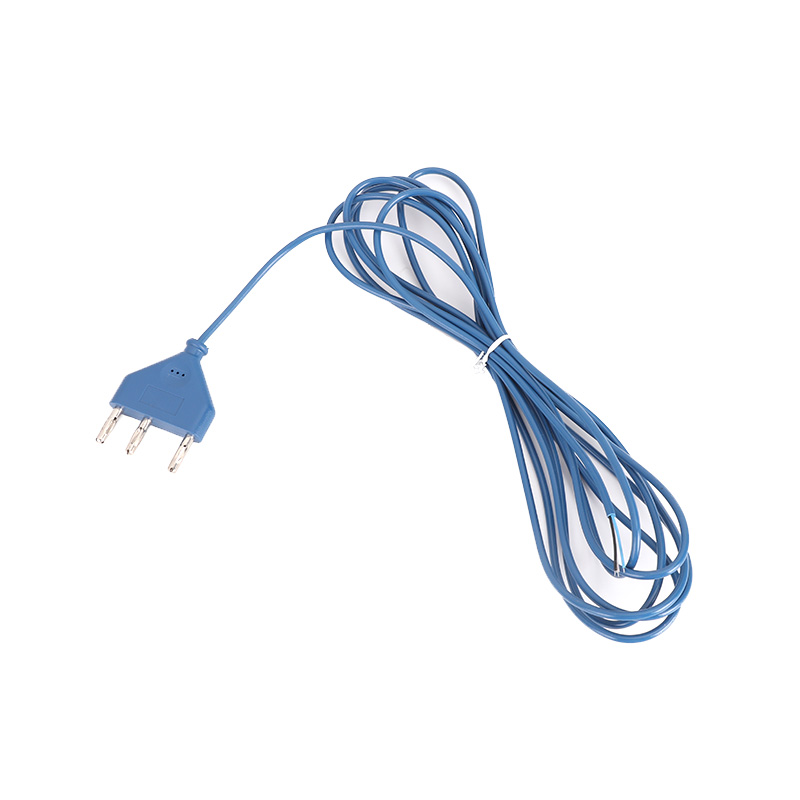 Disposable Monopolar Electrosurgical Pencil CableA disposable monopolar electrosurgical pencil cable for medical device integration, with high-voltage and durability testing; worth reviewing for device-specific cable programs.View Product →
In laboratories, the same caution applies to C13 cords used near heat, chemicals, or moving equipment. The cord jacket must resist the environment, and the connector must remain fully seated. A loose C13 socket can arc, overheat, or interrupt a test. Inspect retention clips, strain relief, and cable jackets as part of routine maintenance.
How to Choose a C13 Cord Set
Start with the equipment inlet and the load, then work outward. A practical buying sequence looks like this:
- Confirm the inlet is C14 and the connector is C13. Do not substitute C19 or C15 without checking the equipment rating.
- Match the current rating. A 10 A C13 cord is not a license to run 10 A continuously in a hot cabinet; leave margin and check local code.
- Select the conductor gauge for the current and length. Longer cords have more voltage drop and should not be chosen only by connector shape.
- Choose the country plug. EU, UK, US, and Korean plug ends are not interchangeable, even when the C13 end is identical.
- Check temperature and environment. Use a C15 assembly where the inlet or surrounding air requires a higher temperature rating.
- Verify approvals and markings. Look for the rating, manufacturer, model, and safety marks; reject unmarked cords.
Length deserves separate attention. A short cord is easy to manage, but a long cord can create a trip hazard, a coil that traps heat, or a voltage drop that affects sensitive equipment. If the installation needs extension, use a listed power distribution product rather than daisy-chaining adaptors. The same discipline applies to cable reels and extension products: length and capacity must be matched to the load.
C13 vs. C15 vs. C19 at a Glance
The table below summarizes the differences that matter at the specification stage. It is a starting point, not a substitute for the equipment label or the local electrical code.
| Connector | Current / voltage | Typical temperature rating | Common use | Mating inlet |
|---|---|---|---|---|
| C13 | 10 A / 250 V | 70 C | Monitors, PCs, PDUs, lab gear | C14 |
| C15 | 10 A / 250 V | 120 C | High-temperature IT and appliance inlets | C16 |
| C19 | 16 A / 250 V | 70 C | Servers, UPS, higher-current equipment | C20 |
Sourcing Signals That Reduce Risk
For a C13 cord program, the supplier's process matters as much as the sample. Ask for the drawing, the conductor size, the jacket material, the temperature rating, and the approval file. A supplier that can show incoming material control, in-process testing, and traceability is better placed to keep a 10 A assembly consistent across shipments.
Experience with export standards is also useful. A C13 connector may be the same, but the plug end and the marking requirements change by market. Manufacturers that already build EU, Korean, and other standard power products are more likely to have the test fixtures and documentation in place. ISO 9001 certification is a baseline, not a guarantee; the audit scope and the product family should match the item being purchased.
Finally, check the mechanical details. Strain relief should hold the cord without cutting the jacket. The connector should seat firmly in the C14 inlet without forcing. The housing should show no flash, cracks, or loose pins. For high-volume orders, request a first-article inspection and a periodic pull test. These checks catch problems that a photo and a current rating will not.
What to Specify Before You Buy
Write the requirement as a short specification: “C13 female, 10 A, 250 V, 70 C, 1.0 mm² conductor, 1.8 m, EU plug, approved to the relevant standard.” Then verify the sample against it. If the application runs hot, change the temperature rating before you change the length. If the equipment inlet is C20, stop and select a C19 cord. If the device is medical, confirm whether a standard C13 cord is permitted at all.
The C13 socket is a small part, but it sits at the boundary between the equipment and the building wiring. Treat it as an assembly with a rating, not as a universal plug. That approach prevents the most common failures: loose fits, overheated cords, wrong plug ends, and unapproved parts entering a controlled environment.
PRODUCTS
ABOUT US
CONTACT INFO.
- +86-18758062352
- +86-0571-64701616
- [email protected]
- No. 7, Xinqu Road, Xin’Anjiang Street, Jiande, Hangzhou, Zhejiang, China

Copyright © 2023 Hangzhou Newmany Electronics Co., Ltd. All Rights Reserved. Power Strip Manufacturer in China| Login

 TOP