
 ENG
 English
 русский
 한국어
 Deutsch

Submit feedback
News
 Home / News / Industry News / Choosing the Best Power Source for a Gaming PC: Amps, Protection, and Cable Run
Choosing the Best Power Source for a Gaming PC: Amps, Protection, and Cable Run
 2026.10.20
 Industry News
An 850 W gaming tower, two 27-inch monitors, a powered speaker pair and a router can place 850 to 1,050 W of continuous demand on a single wall socket, and almost nobody converts that into amps before choosing the strip that has to carry it. At 230 V the desk pulls a little over 4 A. At 120 V it pulls close to 9 A, and one more device pushes it past the 10 A rating many household strips are built around. Nothing dramatic happens at that point, which is exactly the problem: the plug runs warm, the contacts oxidise, and the failure arrives months later.
The best power source for a gaming PC is not the strip with the largest wattage printed on the packaging. It is the one with enough continuous current rating for the entire desk, a real thermal overload breaker rather than a decorative rocker, a cord long enough to reach the outlet in one unbroken run, and a plug standard that matches the country where it will be used. USB ports, independent switches and housing material are refinements that sit on top of that foundation.
Content
- 1 Convert the Desk Load to Amps Before Comparing Models
- 2 From PSU Rating to Real Wall Draw
- 3 Overload Protection and Surge Protection Are Different Jobs
- 4 Outlet Count and Socket Spacing for a Real Desk
- 5 When Individual Switches Earn Their Cost
- 6 Cord Length, Conductor Size and Cable Reels
- 7 Housing Material Is Part of the Electrical Specification
- 8 Match Plug Standard and Certification to the Destination Market
- 9 A Procurement Checklist You Can Apply to a Sample
Convert the Desk Load to Amps Before Comparing Models
Wattage is what buyers recognise, but current is what a strip, its breaker and its cord actually carry. Divide the total continuous load by the mains voltage and compare the result against the strip rating: 10 A, 13 A or 16 A in most of Europe and Korea, 15 A or 20 A on a North American branch circuit.
| Continuous desk load | Current at 230 V | Current at 120 V | Practical note |
|---|---|---|---|
| 400 W (mid-range tower only) | 1.7 A | 3.3 A | Comfortable on any 10 A strip |
| 800 W (tower, two monitors, peripherals) | 3.5 A | 6.7 A | Headroom check needed on a 10 A strip |
| 1,050 W (high-end tower and full desk) | 4.6 A | 8.8 A | Close to a 10 A device rating at 120 V |
| 2,000 W (two towers, or tower plus laser printer) | 8.7 A | 16.7 A | Split across two circuits |
Two conclusions follow. A 16 A strip on a 230 V circuit has generous headroom for any realistic gaming desk, which is why European buyers rarely have to think about the breaker at all. The same desk on a 120 V circuit sits far closer to its limit, and splitting the load across two circuits is usually smarter than buying more sockets on one cord.
From PSU Rating to Real Wall Draw
A power supply rating describes DC output, not consumption at the wall. Divide by efficiency: an 850 W unit running near full load at about 90% efficiency pulls roughly 945 W. Add two 35 W monitors, 20 W of speakers, a 12 W router and a 10 W charger and the desk reaches approximately 1,050 W — 4.6 A at 230 V, 8.8 A at 120 V.
Two effects make the real picture less tidy. Graphics cards draw microsecond transient spikes that can reach 1.5 to 2 times the average, and switch-mode supplies pull a brief inrush current while their capacitors charge. A thermal breaker ignores a microsecond spike by design and reacts to sustained heat instead. That is the correct behaviour, but it also means the breaker should sit 25 to 30% above the continuous load rather than matching the PSU label.
Overload Protection and Surge Protection Are Different Jobs
These two features are marketed together and solve unrelated problems.
- Overload breaker: interrupts a sustained overcurrent and protects the cord and building wiring from heat.
- Surge suppression: clamps short voltage spikes through a sacrificial component and does nothing about a 20 A overload.
- Residual-current device: detects leakage to earth and belongs upstream at the distribution board, not inside the strip.
For a gaming desk, require a resettable overload breaker and confirm its rating in writing. Then check the internal bus and switch contacts, not just the plug: a 16 A plug pattern on a 10 A internal bus is one of the most common shortcuts in low-cost imports, and it is invisible from the outside.
Outlet Count and Socket Spacing for a Real Desk
A gaming desk needs six to nine outlets once the tower, two monitors, speakers, router, desk lamp, charger and a console are counted. Spacing matters as much as count — an angled monitor plug or a power brick can block the neighbouring position on a compact strip, so look for at least 40 mm between socket centres or a staggered layout.
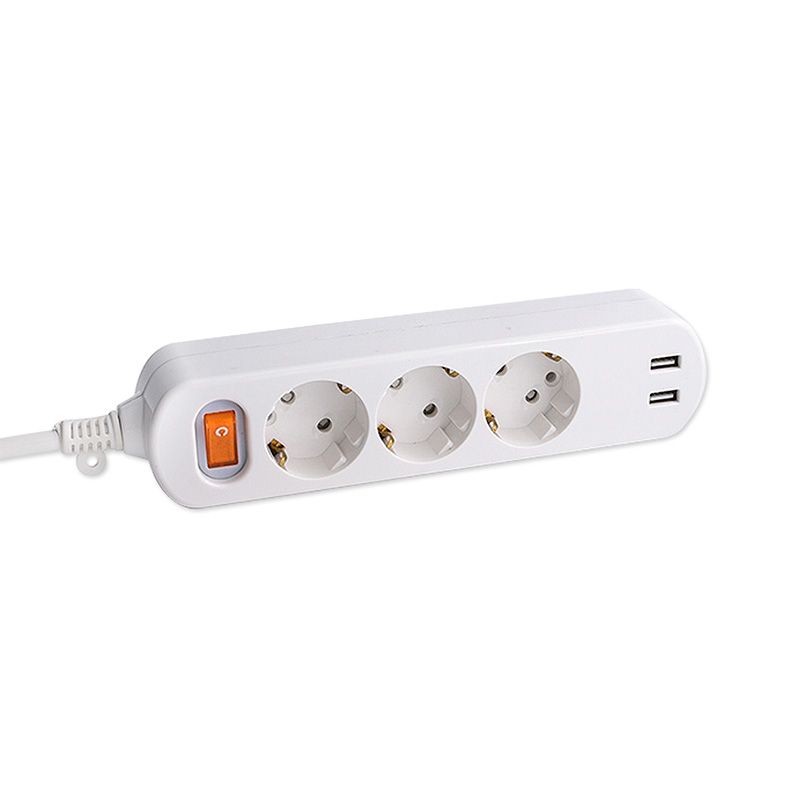
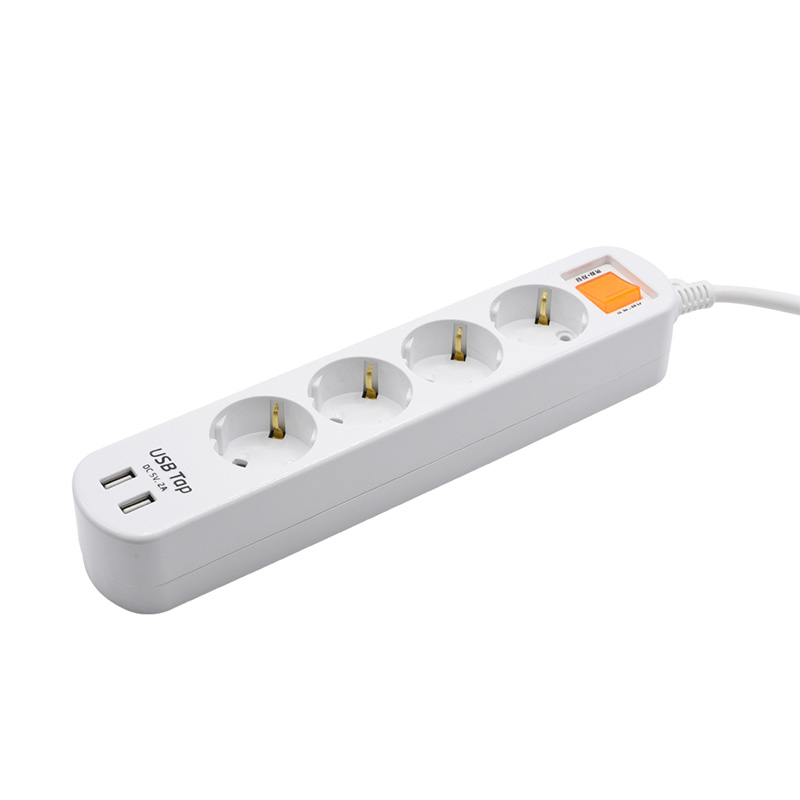 EU Power Strip with 4 Outlets, 2 USB PortsA 4-outlet EU strip with two USB ports and overload protection, useful for core desk devices while charging phones and controllers.View Product →
A four-outlet strip with two USB ports and a single overload-protection switch covers the core load while keeping phone and controller charging off the mains sockets, and a master switch on the input lets the whole desk be isolated at night without unplugging anything.
When Individual Switches Earn Their Cost
Independent rockers matter in two situations: when a tower, a console and a monitor should not all be energised at the same moment, and when one device has to be isolated without shutting down the desk. They also reduce nuisance trips, because inrush current is highest when several supplies charge their capacitors in the same instant. Switching devices on one at a time keeps the total inrush below the breaker threshold.
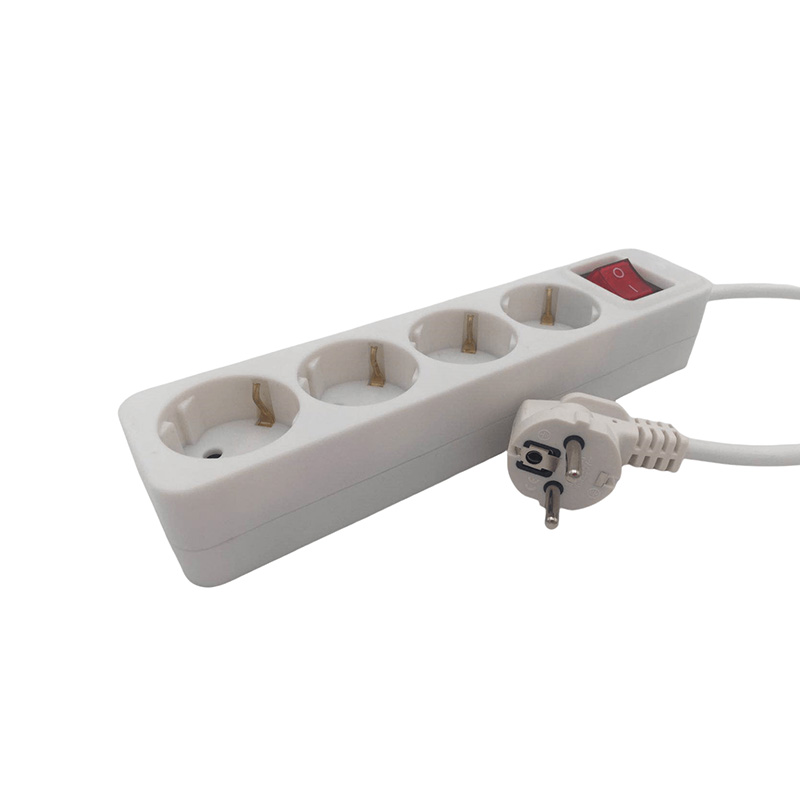
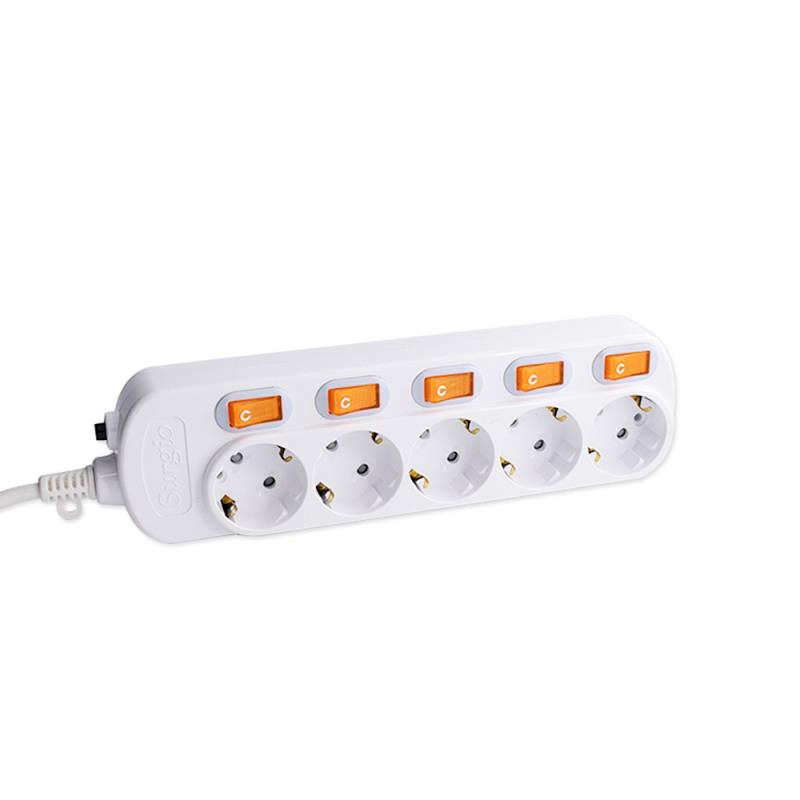
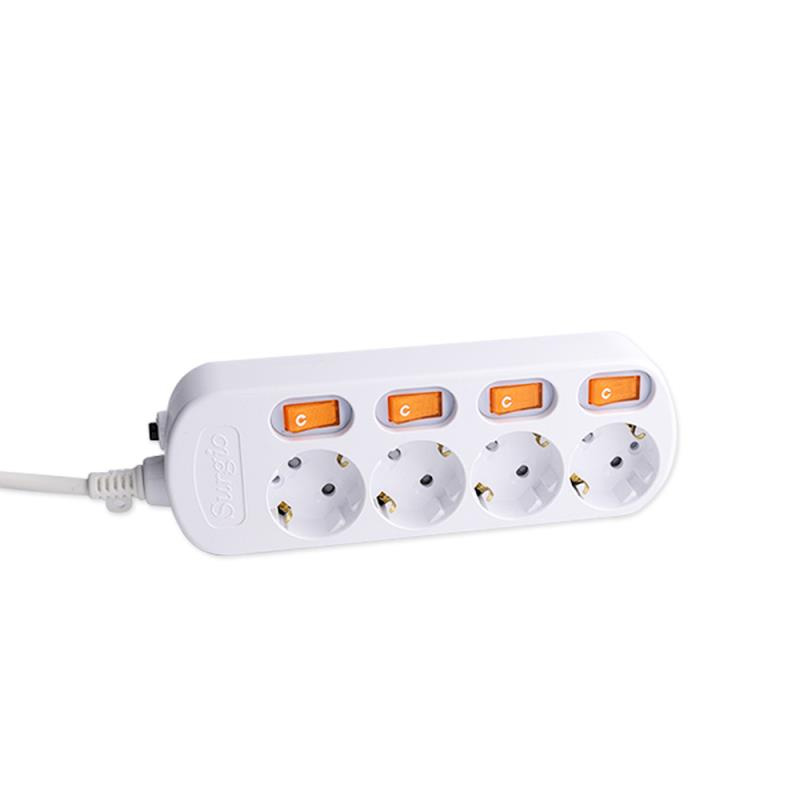 EU Power Strip with 4 Independent SwitchesFour EU outlets with individual switches and a common overload button, helping power devices separately and isolate one load without shutting down the desk.View Product →
The useful combination is a common overload button on the input side together with independent switches on each outlet, positioned so the button stays reachable when the strip is fixed under a desk or flat against a wall.
Cord Length, Conductor Size and Cable Reels
Cord length is an electrical decision, not a convenience. On a 1.5 mm² copper cord, a 10 m run at 6 A loses roughly 2 to 3% of the supply voltage; a 1.0 mm² conductor of the same length loses noticeably more and warms faster. For a full desk load, stay under 10 m, use 1.5 mm² or heavier, and never join two extension cords to reach the wall.
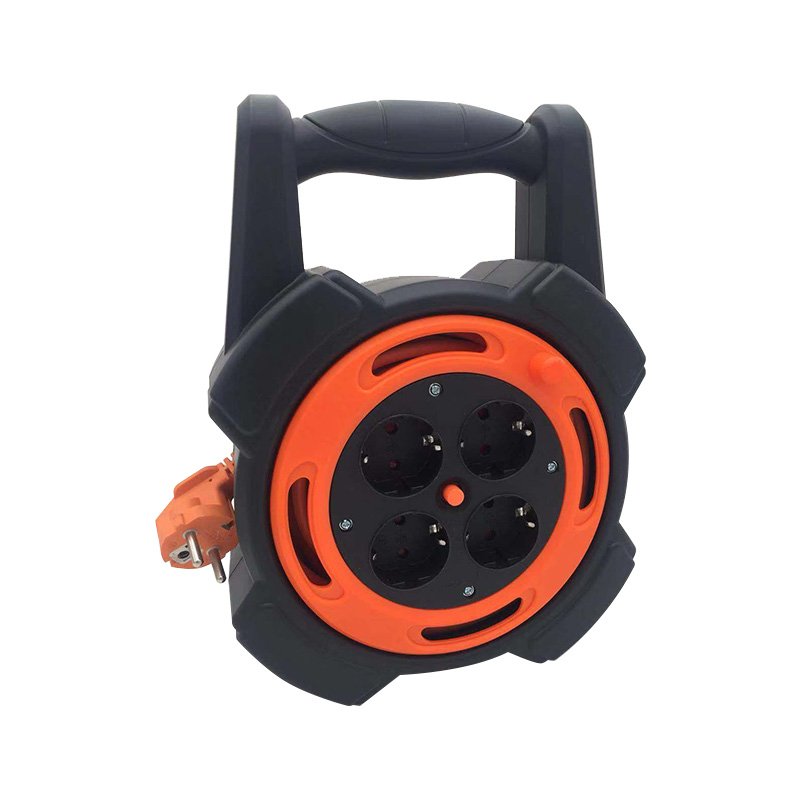 Indoor/Outdoor EU Cable Reel with 10 m CordA 10 m EU cable reel with fireproof PP shell, full copper and overload switch, suited to tidy power runs for movable or across-room setups.View Product →
Where the outlet is across the room or the setup moves between rooms, a reel keeps the surplus cable tidy and provides a handle and a defined working length. Unwind the full length before pulling a high continuous load: a coiled cable cannot shed heat, and its effective rating drops when it is left spooled.
Housing Material Is Part of the Electrical Specification
Most desk strips use polycarbonate (PC) or polypropylene (PP). PC tolerates higher continuous temperatures and holds flame-retardant performance at the socket, where contact resistance generates local heat; a housing that stays rigid and resists creep keeps the contacts aligned through years of thermal cycling. PP handles oils, many chemicals and knocks well, but its heat ceiling is lower, which matters on a strip running at 4 A for hours.
The checks that actually matter apply to either resin: wall thickness around the socket, the flammability and glow-wire rating of the material, and whether the internal bus is one continuous conductor or a set of crimped bridges. The relationship between heat resistance, fire resistance and flame retardancy in PC housings is worth reading before a sample is approved, because those three properties are not interchangeable.
Match Plug Standard and Certification to the Destination Market
The same gaming desk is a different product in Seoul and in Berlin. Korea's 220 V market uses KC-pattern plugs, most of Europe uses Schuko or Euro plugs, and 120 V markets need a different device rating again. A strip qualified for one market is not automatically compliant in another, and shipping a 250 V design into a 120 V market creates both warranty exposure and a genuine fire risk.
A supplier that exports in volume organises its catalogue along those lines, with EU-standard and KC-standard power strips, USB and independently switched variants, cable reels and extension sockets held in the same range. Ask for the certificate number and the standard the product was tested to rather than a general quality claim, and confirm that the ISO 9001 certificate covers the line that will actually build your order.
A Procurement Checklist You Can Apply to a Sample
- Calculate the continuous load at the real mains voltage and require 25 to 30% headroom above it.
- Confirm the overload breaker rating in writing and confirm it is resettable.
- Verify conductor cross-section and cord length; reject two-cord solutions.
- Test socket spacing with angled plugs and bulky power bricks.
- Check the internal bus current rating, not only the plug rating.
- Request the resin's flammability and glow-wire results for the housing.
- Match plug pattern and certification to the destination market.
- Power the full desk on with the master switch ten times in a row and watch for nuisance trips.
Get the current rating, the breaker and the cord right, and everything else becomes preference rather than risk. A 16 A strip on a 230 V circuit with a resettable overload breaker, six well-spaced sockets, a 1.5 mm² cord and the correct plug pattern for the market will carry any gaming desk built this decade without strain at the plug. A strip that measures well on those five points is the best power source for a gaming PC, whatever the front of the box claims.

PRODUCTS
ABOUT US
CONTACT INFO.
- +86-18758062352
- +86-0571-64701616
- [email protected]
- No. 7, Xinqu Road, Xin’Anjiang Street, Jiande, Hangzhou, Zhejiang, China

Copyright © 2023 Hangzhou Newmany Electronics Co., Ltd. All Rights Reserved. Power Strip Manufacturer in China| Login

 TOP