
 ENG
ENG
 English
 русский
 한국어
한국어 Deutsch
Submit feedback
News

Extension Cable Reels: Types, Safety & How to Choose
 2026.02.27
 Industry News
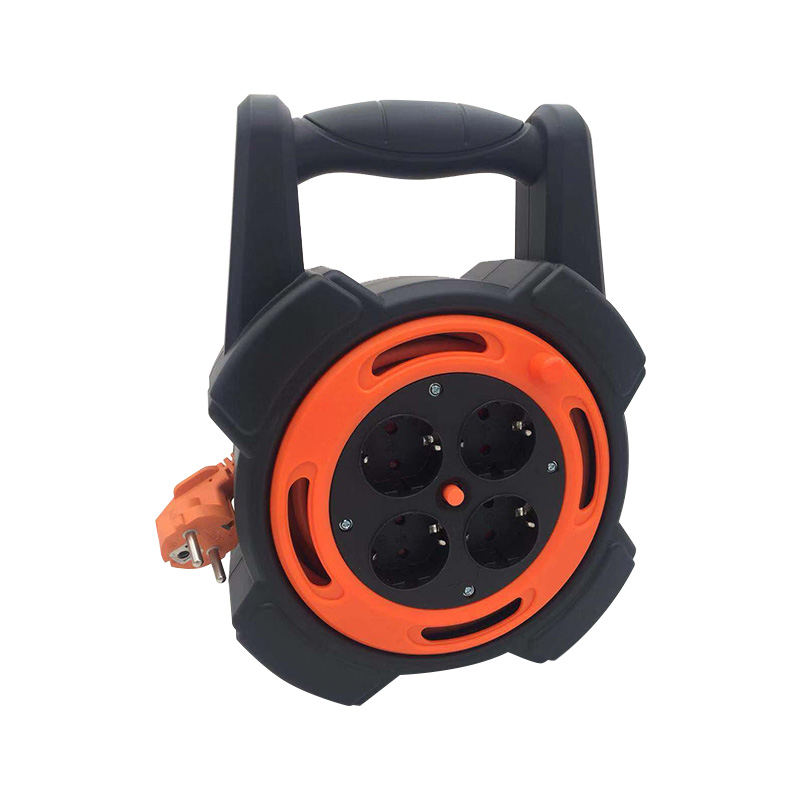
An extension cable reel is a retractable or manual winding device that stores a length of electrical cable — typically 10 to 50 meters — on a rotating drum, with one or more sockets at the cable end and a plug at the fixed end connecting to a wall outlet. It solves the practical problem of getting mains power to tools, equipment, or devices at a distance from a fixed socket, while keeping the cable organized, tangle-free, and safe to use repeatedly.
Choosing the wrong extension cable reel — undersized cable cross-section, wrong IP rating for outdoor use, or insufficient current capacity for the load — creates real fire and electrocution hazards. This guide covers the types available, the specifications that actually matter, safety requirements, and how to match a reel to your specific application.
Content
- 1 Types of Extension Cable Reels
- 2 The Most Important Safety Rule: Always Fully Unwind Before Use Under Load
- 3 Cable Specifications That Determine Safe Load Capacity
- 4 Voltage Drop Over Long Cable Runs: Why Length Matters Beyond Safety
- 5 IP Ratings: Choosing the Right Protection Level for Indoor and Outdoor Use
- 6 RCD Protection: When It Is Required and Why It Matters
- 7 Practical Buying Checklist for Extension Cable Reels
- 8 Maintenance and Inspection to Keep Extension Cable Reels Safe Over Time
Types of Extension Cable Reels
Extension cable reels fall into several categories based on their winding mechanism, intended environment, and application. Understanding the differences helps narrow the choice before looking at specific specifications:
| Type | Winding Method | Typical Cable Length | Best Application |
|---|---|---|---|
| Manual hand-crank reel | Hand crank handle | 10–50 m | Workshop, construction, garden |
| Spring retractable reel | Internal spring auto-retract | 5–20 m | Garage, office, light-duty tools |
| Motorized retractable reel | Electric motor rewind | 20–50 m | Industrial, ceiling-mounted, heavy use |
| Open drum reel (non-enclosed) | Manual wind, no housing | 25–100 m | Industrial sites, temporary power supply |
| Portable plug-in reel | Manual wind, carry handle | 10–25 m | Home DIY, garden, site-to-site use |
Spring Retractable Reels
Spring retractable reels are convenient for frequent use in fixed locations — garages, workshops, and service bays — where the reel is mounted to a wall or ceiling and cable is pulled out to length, then released to auto-rewind. The spring mechanism limits maximum cable length to around 15–20 meters on most consumer models, as longer or heavier cable exceeds the spring's retraction force. The spring tension also means the cable must be fully uncoiled to use safely at full load — a critical safety point covered in detail below.
Open Drum Reels for Industrial Use
Open drum reels — where the cable wraps around a bare spool with no protective housing — are the standard format for industrial and construction site temporary power. The open construction allows the cable to dissipate heat more effectively during high-current use, and the large drum diameter accommodates heavy-gauge cable up to 4mm² or 6mm² cross-section. Many industrial reels are designed to be used partially wound, provided the current rating is derated accordingly — a critical specification difference from consumer reels.
The Most Important Safety Rule: Always Fully Unwind Before Use Under Load
This is the single most critical safety point for extension cable reels, and it is routinely ignored: a cable reel used while partially or fully wound can overheat and cause a fire even when operating below the cable's rated current.
The reason is heat dissipation. When current flows through a conductor, it generates heat proportional to the square of the current (P = I²R). A cable lying flat dissipates this heat along its entire length into the surrounding air. A cable wound tightly on a drum traps heat in the center of the coil — the innermost layers cannot dissipate heat at all. Tests have shown that a 13A-rated cable reel used fully wound with a 13A load can reach temperatures exceeding 100°C at the drum core within 20–30 minutes — sufficient to melt cable insulation and ignite surrounding materials.
Most reputable reel manufacturers print a reduced current rating for wound use — commonly 6A or less when wound versus the full 13A or 16A rating when fully extended. If your application requires full-rated current, fully unwind the cable every time before plugging in.
Cable Specifications That Determine Safe Load Capacity
The cable inside a reel — its conductor cross-section, insulation rating, and number of cores — determines what it can safely power. These specifications are more important than the socket count or reel housing quality:
| Conductor Size | Current Rating (extended) | Max Load (230V) | Typical Application |
|---|---|---|---|
| 0.75 mm² | 6A | ~1,380W | Lamps, phone chargers, low-power electronics |
| 1.0 mm² | 10A | ~2,300W | Drills, small power tools, garden equipment |
| 1.5 mm² | 13–16A | ~3,000–3,680W | Circular saws, pressure washers, heaters |
| 2.5 mm² | 20–25A | ~4,600–5,750W | Large power tools, compressors, welders |
| 4.0 mm² | 32A | ~7,360W | Industrial machinery, site supplies, EV charging |
A common mistake is purchasing a reel based on socket count or cable length alone, without checking the conductor cross-section. A cheap 25-meter reel with 0.75mm² conductors is dangerous for powering a 2,000W pressure washer — even though the plug fits and the reel is fully unwound. Always verify the cable cross-section printed on the cable sheath or in the product specifications before purchase.
Voltage Drop Over Long Cable Runs: Why Length Matters Beyond Safety
Even a correctly rated cable reel causes voltage drop over long distances that can damage sensitive equipment and reduce tool performance. Voltage drop increases with cable length and current, and decreases with larger conductor cross-section.
As a practical example: a 1.5mm² cable carrying 13A over 25 meters drops approximately 8–9 volts — reducing a 230V supply to around 221–222V at the socket end. Most tools tolerate this. However, the same cable over 50 meters at 13A drops approximately 16–18 volts, delivering only 212–214V. This is below the tolerance threshold of many sensitive electronics and can cause motors in power tools to run hot and fail prematurely.
The practical guideline for minimizing voltage drop over long cable runs: upsize the conductor cross-section when run length exceeds 25 meters under significant load. Use 2.5mm² cable for runs of 25–50 meters at loads above 10A, and 4.0mm² for runs beyond 50 meters at high current.
IP Ratings: Choosing the Right Protection Level for Indoor and Outdoor Use
The IP (Ingress Protection) rating on an extension cable reel indicates its resistance to dust and water. This is critical for outdoor, garden, construction site, and industrial use where the reel will be exposed to rain, mud, or wet conditions:
- IP20: Protection against fingers and objects larger than 12mm — no water protection. Suitable for indoor use only in dry locations. Most basic household reels carry this rating.
- IP44: Protected against solid objects larger than 1mm and water splashing from any direction. Suitable for light outdoor use — garden tools, outdoor events, covered construction areas. The minimum recommended rating for any outdoor use.
- IP54: Dust-protected (not fully dust-tight) and protected against water splashing. Suitable for general outdoor work, construction sites, and dusty workshop environments.
- IP55 / IP56: Dust-protected and protected against water jets. Suitable for exposed outdoor use in rain and wet conditions. Appropriate for agricultural, landscaping, and outdoor event power supply.
- IP67 / IP68: Fully dust-tight and protected against temporary or continuous submersion. Used in specialist industrial and marine applications — uncommon in standard cable reels.
Note that the IP rating applies to the reel housing and drum — not necessarily to the sockets on the cable end. Check that sockets also carry adequate ingress protection for outdoor use, as the socket face is often the most vulnerable point to water entry on outdoor-rated reels.
RCD Protection: When It Is Required and Why It Matters
A Residual Current Device (RCD) — also called a Ground Fault Circuit Interrupter (GFCI) in North America — monitors the current flowing in and out of a circuit and trips within 30 milliseconds if it detects a leakage current of 30mA or more. This is fast enough to prevent electrocution in most circumstances, as the threshold for ventricular fibrillation in adults is approximately 30–100mA sustained for more than 30ms.
For extension cable reels used outdoors or in damp environments, RCD protection is a legal requirement in many countries including the UK (BS 7671 wiring regulations) and Australia (AS/NZS 3760). Even where not legally mandated, it is strongly advisable for any reel used outdoors, in a garage, near water, or on a construction site.
RCD protection can be provided in three ways:
- Built into the reel: Some outdoor-rated reels include an integrated RCD in the reel housing. The most convenient option — protection travels with the reel.
- RCD plug adapter: A plug-in RCD that sits between the reel's plug and the wall socket. Inexpensive (typically £10–£25) and can protect any reel that lacks built-in RCD protection.
- RCD-protected circuit at the distribution board: If the wall socket you connect to is protected by an RCD at the consumer unit, the entire circuit including the reel is protected. Verify this with a qualified electrician before relying on it.
Practical Buying Checklist for Extension Cable Reels
Apply these criteria in order when selecting an extension cable reel for any application:
- Calculate maximum load current: Add the wattage of all devices you will connect simultaneously and divide by your mains voltage (230V in Europe, 120V in North America). This gives the minimum current rating the reel and cable must support.
- Verify conductor cross-section: Confirm the cable cross-section printed on the cable sheath matches the load and length requirements from the table above. Reject any reel where the conductor size is not stated in product documentation.
- Choose the correct cable length: Buy the length you actually need — not the longest available. Excess cable adds weight, increases voltage drop, and adds thermal mass that must be fully unwound before high-current use. A 25-meter reel for a 15-meter task is both safer and more practical than a 50-meter reel.
- Check IP rating for environment: Indoor dry use — IP20 is acceptable. Any outdoor, damp, or dusty use — IP44 minimum, IP54 or higher preferred.
- Confirm RCD protection: For outdoor use, ensure the reel has built-in RCD protection or plan to use an RCD plug adapter.
- Verify certifications: Look for safety certifications relevant to your market — CE marking in Europe, UL listing in North America, or SAA approval in Australia. Uncertified reels from unknown manufacturers have no verified protection against cable failure or housing fire risk.
- Assess mounting and storage needs: Wall-bracket or ceiling-mount capability for fixed workshop use; carry handle and compact drum for portable site use; automatic retraction only if cable length and load requirements fall within the spring mechanism's capacity.
Maintenance and Inspection to Keep Extension Cable Reels Safe Over Time
Extension cable reels are subject to mechanical wear, cable flex fatigue, and insulation degradation over time. Regular inspection prevents failures that develop gradually and are invisible until a fault occurs:
- Inspect the entire cable length every 3–6 months by fully unwinding and running your hand along it feeling for kinks, stiff spots, or flattened sections that indicate internal conductor damage.
- Check the plug and all sockets for cracking, discoloration (browning or melting indicates previous overheating), loose pins, or damaged shutters.
- Inspect the cable entry point where it exits the reel drum — this is the highest-flex point and the most common location for insulation cracking and conductor break. Any visible damage at this point warrants immediate retirement of the reel.
- Test RCD protection monthly using the test button on the reel or RCD adapter. A functional RCD trips immediately when the test button is pressed and resets when the reset button is pressed.
- In commercial and construction environments, reels should undergo formal Portable Appliance Testing (PAT) at intervals defined by the usage level and environment — typically annually for office use and every 3 months for construction site use under UK HSE guidance.
- Never repair damaged cable insulation with electrical tape as a permanent fix — replace the reel or have the cable professionally replaced. Tape repairs are only acceptable as a temporary measure to remove a damaged reel from service safely.
PRODUCTS
ABOUT US
CONTACT INFO.
- +86-18758062352
- +86-0571-64701616
- [email protected]
- No. 7, Xinqu Road, Xin’Anjiang Street, Jiande, Hangzhou, Zhejiang, China

Copyright © 2023 Hangzhou Newmany Electronics Co., Ltd. All Rights Reserved. Power Strip Manufacturer in China| Login

 TOP
TOP